
 NuVolta Technologies announced its second-generation charge pump fast charging IC — NU2205, which is the first 100W charge pump fast charging IC in the whole industry. NU2205 is the leading fast charging IC for a 2S battery with a 4:2 charge pump fast-charging architecture for ultra-fast charging applications in flagship smartphones and other mobile devices. The innovative 2S battery fast charging architecture enables the charging power from 60W to 120W, and further increases to 200W.
In the 5G era, the power consumption of smartphones has increased significantly, and the demand for fast charging has become much stronger. As we all know, the world’s first generation of fast charging IC was launched by TI in 2017, which improved smartphone charging from 10W to 30W, even 40W. However, the battery anxiety keeps increasing with more and more powerful APPs and games on our smartphones. It keeps pushing for higher charging power up to 60W, or even 120W to shorten the charging time and cool the charging temperature. 1S battery charging limitation becomes the bottleneck to push for higher charging power. NU2205 brings an innovative 2S battery charging architecture, which changes the charging solution fundamentally to meet the increased charging power.
With the launch of NU2205, NuVolta will provide mobile phone customers with a fast-charging solution of up to 200W.
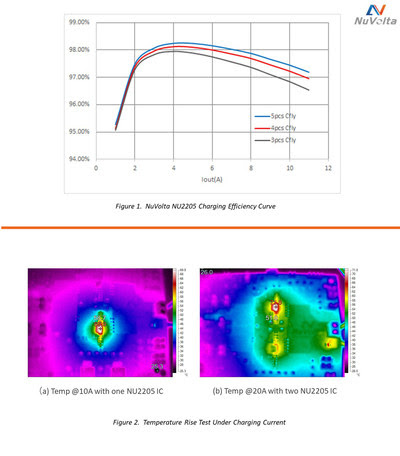
NU2205 utilizes an innovative 2S battery architecture to bring all-around advantages in power levels greater than 60W. The following are the experimental results of efficiency, temperature rise, and current.
High efficiency is the most critical parameter in fast-charging applications. The NU2205 not only improves the work efficiency through the innovative internal structure but can adjust the efficiency through the operating frequency. Under the 10V ACDC adapter input, the charging efficiency of the 2S battery in the 2:2 mode can reach up to 99.2%.
Under the conditions of 25°C ambient temperature and 16V input, when 2S batteries are charged at 10A and 20A current, the temperature rise is 44.9°C/46.8°C respectively shown as follows.
In addition to the 4:2 2S battery charge pump mode, NU2205 also supports the 2:2 2S battery direct charging mode. In the 2:2 direct charging mode, the charging efficiency is as high as 99.2%. In high power charging application, it provides the possibility of pulse switching between 4:2 and 2:2 modes to reduce the system’s heat. Due to the innovative design, NU2205 can also support both 2:1 and 1:1 1S battery fast charging modes.
NU2205 adopts NuVolta’s 2S battery 4:2 charge pump fast-charging architecture, and it supports charging power up to 100W with a single chip.
Along with OPPO launched the first generation of low-voltage high-current fast charging (VOOC) in 2014, the fast charging solution has dramatically changed the way of battery charging in smartphones. In 2017, the 1S battery charge pump solution was commercially available by TI, and the charging power exceeded 40W, 50W, and 60W in 1S battery charging. The current charges into the 1S battery have also increased from the initial 5A to 12A. That means when the battery’s internal resistance is only 5mΩ, the power loss of the battery exceeds 0.7W. The higher current brings more heat that induces huge challenges to the design of the battery protection board and the internal resistance of the battery cell.
Taking battery protection MOSFET as an example. In order to meet the application of fast charging and high current, the resistance of MOSFET has been reduced from 5mΩ to 1.1mΩ. It means the battery protection MOSFET performance has approached the device limit. Therefore, the 1S battery fast charging encounters the charging power limitation.
The 2S battery fast charging solution doubles the battery voltage at the charging output terminal, reduces the current into the battery by half at the same charging power, and reduces the battery’s heat to 25%. In the same 60W charging power level, the current to the battery drops to 6A. When the battery pack’s internal resistance keeps 5mΩ, the power loss of the battery is significantly reduced to 180mW; When the current to battery keep 12A, 2S battery fast charging can break through the charging power limit to 120W or even 200W.
The second-generation charge pumps fast charge IC – NU2205 adopts 4:2 charge pump architecture. This architecture and integrated FET have been optimized to achieve a 50% duty cycle. The architecture lowers down the current of the USB cable to half of the charging current to the battery, reducing the loss of the charging cable and limiting the temperature rise in the application. The two-phase architecture lowers down the input capacitance requirements while improving the output voltage ripple.
The input 20V voltage is reduced by 50% at the battery pack’s side and the charging current of the battery is increased to 12A current, which is twice of the input current. In light of the current double structure, the input current is limited to 6A that can realize high power transmission while no need to upgrade the charging cable, demonstrating advantages of the 2S battery architecture.
Furthermore, NU2205 supports charging parallelly. When two NU2205 ICs are used in parallel, the charge pump ICs will output 120W power. When three NU2205 ICs are in parallel, the charging power exceeds 200W.
In high-power charging applications, efficiency and heat are the most important considerations. However, in a charging system, besides efficiency, the most important consideration is charging safety. NU2205 integrates up to 34 levels of safety protections, such as protections of input and output voltage and current, battery voltage and current, and temperature, etc. That protects the system and prevents abnormal conditions damaging the battery and system. We care more about charging safety than you.
NuVolta’s competitive advantage is also reflected in the existing leading wireless fast charging technology. Together with the world-leading wireless fast charging solution, the newly launched 100W fast charging solution enables NuVolta to be a unique high-performance power semiconductor company with competed wireless and wired fast charging solutions.


Leave a Reply