• Skip to primary navigation
  • Skip to main content
  • Skip to primary sidebar
  • Skip to footer
  • Subscribe
  • Advertise

Power Electronic Tips

Power Electronic News, Editorial, Video and Resources

  • Products
    • Power Supplies
    • AC-DC
    • DC-DC
    • Battery Management
    • Capacitors
    • Magnetics
    • MOSFETS
    • Power Management
    • RF Power
    • Resistors
    • Transformers
    • Transistors
  • Applications
    • 5G
    • AI
    • Automotive
    • EV Engineering
    • LED Lighting
    • Industrial
    • IoT
    • Wireless
  • Learn
    • eBooks / Tech Tips
    • EE Training Days
    • FAQ
    • Learning Center
    • Tech Toolboxes
    • Webinars & Digital Events
  • Resources
    • Design Guide Library
    • Digital Issues
    • Engineering Diversity & Inclusion
    • LEAP Awards
    • Podcasts
    • White Papers
  • Video
    • EE Videos & Interviews
    • Teardown Videos
  • EE Forums
    • EDABoard.com
    • Electro-Tech-Online.com
  • Engineeering Training Days
  • Newsetter Subscription

An overview of fan bearing designs

May 28, 2019 By Aimee Kalnoskas Leave a Comment

by Ryan Smoot, CUI Devices

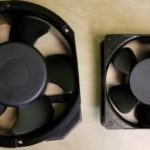
Fans are a crucial feature of many electronic systems, maintaining operation within a certain temperature range, while ensuring electronics are working at their optimum level across their operational lifetime. Key to a fan’s design is the consistent running of the bearing on which the rotor spins. The sleeve bearing and the ball bearing might be the two designs most commonly used, but what are the pros and cons of each and is there a third option?

Sleeve bearing fans have a simple design, they are rugged, cost-effective, and not too noisy. However, their design of a central shaft enclosed in a sleeve assembly means they are more liable to erosion and lubricant leakage which leads to a lower MTBF than ball bearing fans.

The ball bearing fan on the other hand, with its more complex design employing a ring of balls around its shaft, is less prone to deteriorate and operates at higher temperatures in any orientation. However, this leads to a design that is more expensive and noisier than the sleeve bearing option.

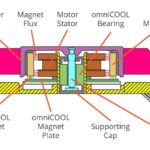
The CUI Devices’ omniCOOL system uses magnetic rotor-balancing together with an improved sleeve bearing, it offsets the drawbacks of other fan designs by working like a spinning top. The magnetic structure results in a fan that can be deployed at any angle, with minimal friction (no lubricants or washers required), less noise, and can function at higher temperatures.
Read the full blog post here


You may also like:

  • fan bearings
    Bearing trade-offs for cooling fans
  • metal and plastic fans
    How cooling fans earn different IP ratings

  • Passive cooling options and considerations (Part 1)
  • CFD model
    Forced Air Cooling and Fan Selection

Filed Under: Fans Tagged With: cuidevices

Reader Interactions

Leave a Reply

You must be logged in to post a comment.

This site uses Akismet to reduce spam. Learn how your comment data is processed.

Primary Sidebar

Featured Contributions

How to design ultra-low-power smart thermostats without a C-wire

Vertical power delivery reduces losses in AI processor designs

Protecting Ethernet interfaces in telecommunications applications against common high energy surges

Ionic cooling: a silent revolution in thermal management

Robust design for Variable Frequency Drives and starters

More Featured Contributions

EE LEARNING CENTER

EE Learning Center

EE TECH TOOLBOX

“ee
Tech Toolbox: Sensors
In this Tech Toolbox, we cover some of those technologies driving the next generation of connected systems, including ultra-low-power sensing strategies that extend node battery life, and 60 GHz CMOS radar for contactless health and presence detection.

EE ENGINEERING TRAINING DAYS

engineering
“power
EXPAND YOUR KNOWLEDGE AND STAY CONNECTED
Get the latest info on technologies, tools and strategies for EE professionals.
“bills

RSS Current EDABoard.com discussions

RSS Current Electro-Tech-Online.com Discussions

  • Voltage comparator circuit verification
  • infiniBand Layer 1 specifications testing question
  • Why aren’t the power windows in my 2006 Volkswagen Polo 2006 working despite repairing the control unit circuit board?
  • block RF
  • Momentary SW to Latch and Control IC EN

Footer

EE World Online Network

  • 5G Technology World
  • EE World Online
  • Engineers Garage
  • Analog IC Tips
  • Battery Power Tips
  • Connector Tips
  • EDA Board Forums
  • Electro Tech Online Forums
  • EV Engineering
  • Microcontroller Tips
  • Sensor Tips
  • Test and Measurement Tips

Power Electronic Tips

  • Subscribe to our newsletter
  • Advertise with us
  • Contact us
  • About us

Copyright © 2026 · WTWH Media LLC and its licensors. All rights reserved.
The material on this site may not be reproduced, distributed, transmitted, cached or otherwise used, except with the prior written permission of WTWH Media.

Privacy Policy