
by Christine Young, blogger, Maxim Integrated
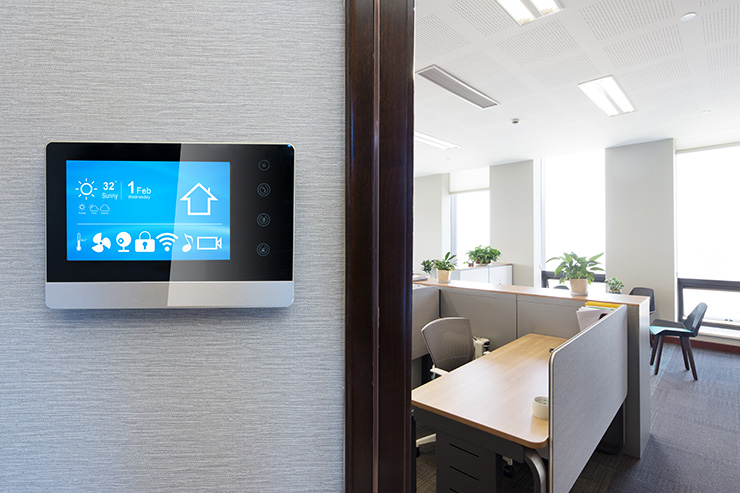
Thanks to sophisticated building automation technologies, today’s buildings can do a lot for themselves, minimizing some of the human intervention that has traditionally been required. Heating and cooling, lighting, access control, and security are just a few of the functions that can now be automated. With modern control and automation techniques, building operators can manage their sites remotely via software, networked automation equipment, analytics, artificial intelligence (AI), and the cloud. Automation systems are capable of monitoring an array of variables in real-time and, with analysis of historical data, can adjust the end devices accordingly. As a result, these systems contribute to a higher level of comfort, lower carbon footprint, and energy and cost savings.
Designing these smart building automation systems calls for special attention to overcoming challenges in areas such as energy efficiency, safety, reliability, and solution size. The architecture for a building automation system includes layers for management, control, and the field.
- From a central spot, the management layer operates and controls the smart building. Actions can be taken as problems are uncovered in real-time.
- The control layer handles the building’s equipment control at the hardware level
- The field layer utilizes intelligent sensors and actuators to collect data and perform various tasks
Aside from sensors and actuators, the other underlying electronic components enabling smart building functions include controllers and I/Os. All of these components in the field require processors and connectivity interfaces. This presents some new requirements on system hardware:
- Smaller component sizes to accommodate additional electronics in the same chassis
- Better energy efficiency to perform within the same or smaller thermal budget
- Enhanced electrical and mechanical safety and reliability to reduce downtime
To learn how power management electronics, including small, highly integrated and highly efficient power supply solutions, can help address these challenges, read the white paper, “Meeting the Power Challenges of the Smart Building.”
Smart factories demand small, reliable, energy-efficient technologies
Like their smart building counterparts, smart factories also rely on electronic equipment to collect, synthesize, and act upon data. Driven by the vision of Industry 4.0 and industrial internet of things (IIoT) automation technologies, smart factories are delivering manufacturing efficiencies, throughput improvements, and maintenance cost advantages. The benefits stand to increase as more manufacturing lines go digital. However, as with smart buildings, designing the systems to enable increased intelligence as well as automation also requires addressing issues pertaining to energy efficiency, safety, reliability, and solution size.
Smart factories rely on the integration of time-sharing IT systems for data-centric computing with real-time operational technology systems that monitor and control events, processes, and devices. Sensors deployed across the factory floor that are networked to I/O modules, actuators, controllers, and to the enterprise cloud make a variety of automated capabilities possible. For example, smart manufacturing equipment such as robots can pick and pack goods, perform certain manufacturing functions, and handle their own maintenance tasks. Smaller system sizes are giving rise to more modular manufacturing lines. An example is a networked set of assembly-line robots that perform functions in a sequence—if similar robots are in this set, an adjacent robot can easily cover for a malfunctioning counterpart. Including AI algorithms in the system can equip that system to identify and potentially resolve manufacturing bottlenecks in real-time.
Again, as with smart buildings, the electronic components inside smart factory systems also need lots of processors and connectivity interfaces. Given this, the challenges for designing these systems are also similar, with requirements for higher energy efficiency, reduced solution size, and increased safety and reliability. Again, power management electronics can help address the challenges in designing for smart factories. To learn more, read the white paper, “Meeting the Power Management Challenges of the Smart Factory.”
A similar version of this blog post was originally published on Maxim’s mgineer blog: https://www.maximintegrated.com/en/design/blog.html




Leave a Reply