
The high-speed all-electric railroad locomotive uses a catenary-wire system and pantograph power-transfer arrangement, which appears to violate good engineering practice and should not work. Still, it does, transferring hundreds of amps via a contact point moving at over 100 miles/hour.
Part 3 looked at the pantograph and catenary power system in more detail. This part further explores the operation and one serious problem which affects it.
Overhead elements of the catenary system include wires, of course, plus insulators, arms, and poles. And the overall system is effective and reliable, as proven by its extensive record in the field. Even so, there are potential issues with the electrical and mechanical aspects of these installations. The system is subjected to natural wear, environmental factors such as weather and temperature variations, and contamination from its surroundings. Even newly installed systems are not immune to these issues, due to factors such as Improper installation of wires, insulators, and other factors.
An important diagnostic feature for detecting faults on the high-voltage electrical supply is corona partial discharge (PD), a localized dielectric breakdown of a small portion of a solid or fluid electrical-insulation system under high-voltage stress. Abnormal unexpected local electrical conditions trigger this discharge. These faults are mostly invisible to unaided eyes and thus overlooked unless the dedicated corona-detection cameras are used (Figure 1).
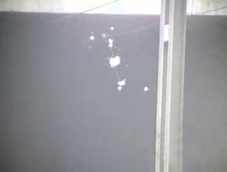

Corona discharge has serious negative consequences, as its local ionization process generates ozone plus organic and inorganic acids. Corona derivatives oxidize the composite-material insulators of the system, then lose some of their insulation characteristics. Metallic elements of the system also get corroded, resulting in mechanical faults. Catenary wires break due to arcing at the points of the locomotive pantograph, which picks the power off the overhead lines, leading to their collapse.
One of the best methods to diagnose insulation failure is partial discharge detection, so corona must be reliably detected, and as soon as possible. However, this has been difficult to do in practice due to the nature and location of the problem and the challenge of actually seeing corona. For this reason, most inspection systems are limited to installations with non-overhead wires, such as substations and distribution points, where the inspection can be done more slowly, using fairly cumbersome systems.
The problem of corona and its consequences is well known, and new techniques are being developed to address the problem of detecting corona on overhead lines easily and reliably in real-time. For example, the DayCor® RAIL bi-spectral imaging system from Ofil Systems is an automatic diagnostic tool that detects corona via a “solar-blind” camera in contrast, while the faulty sources themselves are detected via the visible channel. It incorporates UV-sensitive ICCD cameras, special Catadioptric UV lenses, and absorption-type solar-blind filters to eliminate solar blinding.
The outputs of both video channels are merged into one image to clearly show the pinpointed corona and its emitting source. The DayCor® Rail system is mounted on a testing rail wagon for observing the overhead lines, detecting and recording the presence of corona, and flagging the location via its GPS subsystem. The video-image clips are analyzed automatically and linked to a readable report generated at the end of each run. (There is also a drone-based version for targeted “spot inspections,” but most railroads use the track-based system, which is easier to manage and runs directly along and under the wires of interest.)
It may seem that using a video system to “see” corona is an obvious solution, so what has delayed its deployment in practice? In short, it requires the ability to combine UV and visible-light sensing, while not being blinded by the sun, thus allowing unrestricted daytime operation. Note that the corona itself is not heat-dissipative and has almost no heat signature; it is therefore not a good candidate for detection by an infrared (IR) cameras.
Conclusion
The ability of the pantograph pickup and the catenary system to perform and do so reliably at such high speeds is a testament to the fact the even designs which are inherently contrary to basic rules can be made to work, with smart engineering and practical experience. Here, the well-known guidelines calling for firm, fixed, tight connections to deliver power at these current levels are ignored, and the challenges of delivering power via high-speed moving contacts have been met and reliably overcome.
EE World References
“Electrified Locomotives, Tunnels, and the Pennsylvania Railroad: Astonishing engineering but a partially sad ending, Part 1: The challenge”
“Electrified Locomotives, Tunnels, and the Pennsylvania Railroad, Part 2: The tunnels”
“Electrified Locomotives, Tunnels, and the Pennsylvania Railroad, Part 3: The station”
IGBT 1,200V/900-A-rated modules handle industrial drives, heavy-duty vehicles, power inverter apps
Gate-driver system targets new 1.7-kV to 4.5-kV IGBT/SiC dual power modules
IGBT module platform handles 450-A at up to 6.5 kV
Magnetic gear tooth sensor IC optimized for traction motor apps
Wide-input-range, high power density dc-dc converters optimized for railway traction, rolling stock apps
DC-DC Converters for Railway Traction and Rolling Stock Applications
External References
- Engineering Toolbox, “Cable Loads”
- The Railway Technical Website
- Ofil Systems, DayCor Rail
- Engineering Master, “Working of electric locomotive”
- Engineering Master, “What is Pantograph?”
- Allied Insulators, “Transmission & Distribution”
- “Railway Signalling Concepts”
- net, “Electric Traction Systems”
- Wikipedia, “Third Rail”
- Pennsylvania Railroad GG-1 Electric Locomotive
- Curbside Classic, “Trackside Classic: Pennsylvania RR GG1 #4935


Leave a Reply