
Flow batteries are suited for use in several application areas, including utility-scale energy storage, microgrids, renewables integration, backup power, and remote and off-grid power. Flow batteries are highly scalable, and their power and energy ratings can also be scaled independently. They have very little or no self-discharge current.
Flow batteries have demonstrated cycle lives of over 10,000 cycles with minimal capacity degradation. These systems typically have wider operating temperature ranges than conventional rechargeable batteries, and they are generally present little or no fire hazard and limited toxicity. But those advantages come with associated costs.
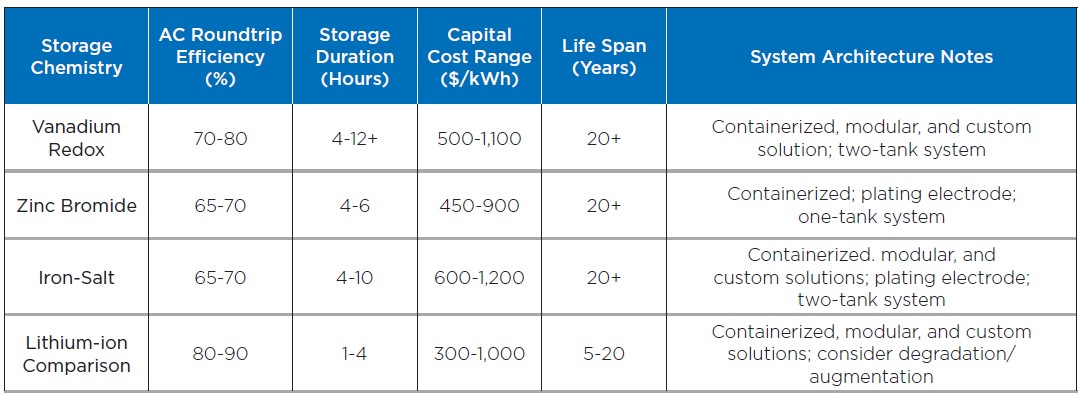
Flow batteries are a developing and immature technology and are, therefore, still declining in cost. Competitive systems based on Lithium-ion batteries, on the other hand, benefit from the commodity pricing associated with the highly-developed status of Lithium-ion technology. The plumbing for flow batteries, the need for controls, cooling systems, pumps, and other active components also contributed to the cost of flow batteries compared with conventional rechargeable batteries such as lithium-ions. Those “balance of system” elements also add maintenance costs for flow batteries.
In addition, flow batteries typically need a finite time for startup that can range from a few tens of milliseconds to tens of seconds, or even longer, to reach full power. Ramp up times can be kept to the millisecond range if the pumps are kept running continuously.
Flow batteries are scalable
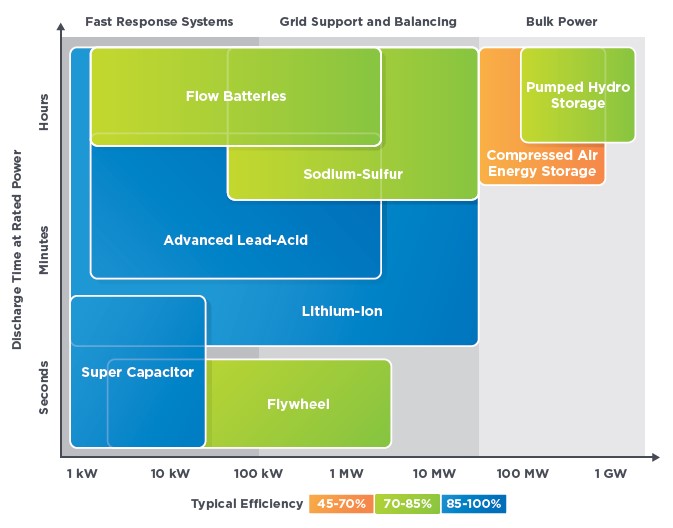
Vanadium flow batteries, and flow batteries, in general, offer users the ability to scale the system in terms of both energy storage capacity and power delivery capability. As shown below, flow batteries store electricity as chemical energy in two large tanks. The tanks are filled with salts dissolved in inorganic acids. The tanks are connected with one or more electrochemical cells via which the flow batteries are charged and discharged. The surface area of the cells determines the output of the batteries. Capacity can be changed easily by increasing the size of the tanks.
From microgrids to grid-scale storage with renewables
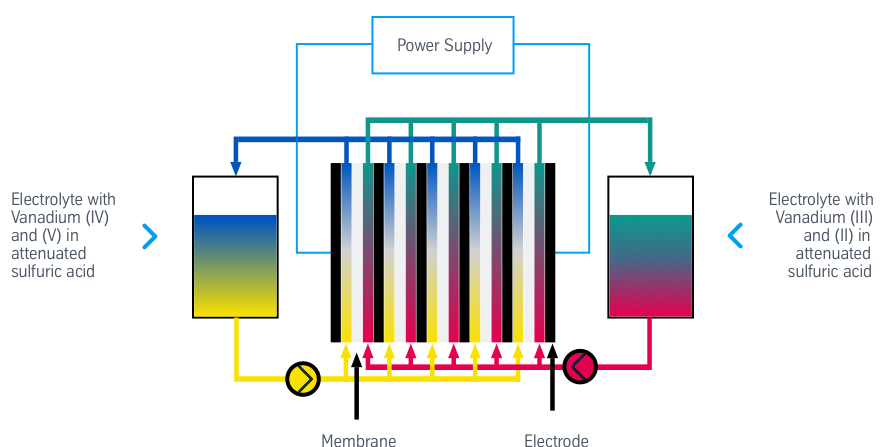
As the potential size of flow batteries increases, so does the potential to use flow batteries in utility-scale installations. In applications such as renewables integration, load shifting, and peak shaving, flow batteries compete with other technologies such as various rechargeable batteries and thermal energy storage. In wind farms, flow batteries can store excess electricity produced when it is very windy and then feed it back into the grid when the wind dies down.
According to a recent study by the National Renewable Energy Laboratory (NREL), emerging large-scale energy storage technologies are making 100% penetration by renewable energy sources an increasing possibility. NREL’s Renewable Electricity Futures Study estimated that 120 gigawatts of storage would be needed across the continental United States by 2050 when the scenario imagined a future where 80% of electricity will come from renewable resources. The country currently has 22 gigawatts of storage from pumped hydropower, and another gigawatt in batteries.
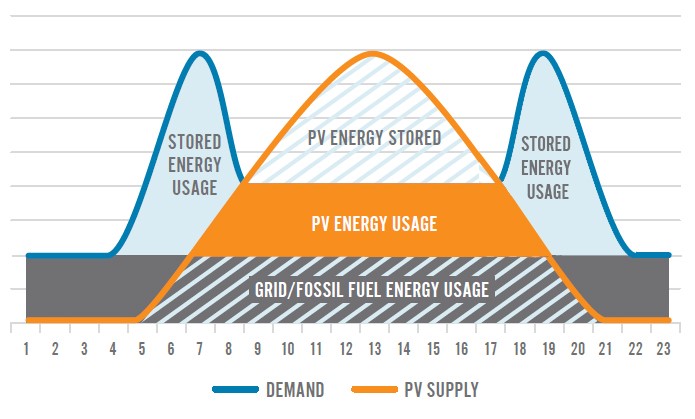
Other utility-scale and microgrid applications for flow batteries include:
- Behind the meter storage for lower utility rates
- Volt/VAR support
- Peak shaving and replacing high-cost natural gas and diesel generators
- Electricity arbitrage between high-cost and low-cost suppliers and markets
Remote power and telecommunications backup power
For remote power and telecommunications backup power 48-Vdc zinc-bromine flow batteries, such as those offered by Redflow, solve many of the problems that impact telecommunications providers These include the ability to operate in warm (up to 50 degrees C, 122 degrees F) and dusty conditions without active cooling; long-term storage at any state of charge, from empty to full for up to 10 years, without damaging the battery; and construction materials with little resale value, making them less attractive to thieves. These features can make flow batteries especially desirable in developing nations in Africa, Asia, and the Indian subcontinent, where wireless telephony and Internet access have leapfrogged wired telco infrastructure, often in areas with unstable or no grid access.
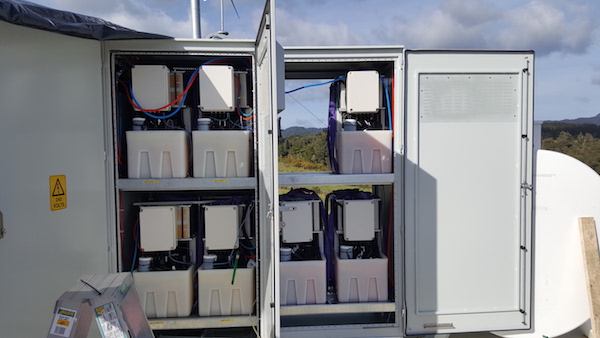
Seven zinc-bromine flow batteries installed at a remote telecommunications site (Image: Redflow)
Redflow also offers a Large Scale Battery (LSB) reference platform that demonstrates a straightforward and proven model for deploying the company’s zinc-bromine flow batteries in large energy storage systems. Deployed in a six-meter (20-foot) shipping container, Redflow’s LSB reference platform contains as many as 45 zinc-bromine flow batteries and six 12kW battery inverter/chargers, providing users with 24/7 monitoring and scalable energy capacity to as much as 450 kilowatt-hours.
References
Declining Renewable Costs Drive Focus on Energy Storage, National Renewable Energy Laboratory
Flow batteries offer utilities another energy storage option, Burns McDonnell
Redox flow batteries: Energy storage systems for renewables, thyssenkrupp

Just a handful of the ‘current’ large scale Flow-Battery (based on Vanadium) there are. You rather suggest Flow Batteries are relatively small …. well Dalian in China is about to commission (in the the next 2-3 months) an 800MW system (just as a start). In the middle of a city of 8m as well
1,000 MWh——- China – Jiangsu TianWan nuclear station (4,500 tonnes)
1,000 MWh——- China – Jiangsu offshore wind integration (4,500 tonnes)
—800 MWh—— China – Shijiazhuang (3,600 tonnes)
—800 MWh—— China – Dalian (3,600 tonnes in 2 stages)
—640 MWh—— South Africa – Eskom BESS phase 2 (2,880 tonnes max)
—500 MWh—— China – Hubei Zaoyang Ph 2 (VRB Energy) (2,250 tonnes)
—400 MWh—— China – Yancheng (Shanghai Electric Group) (1,800 tonnes)
—400 MWh—— China – Wuhan (1,800 tonnes)
—332 MWh—— S. Africa – Eskom BESS phase 1 package 2 (1,494 tonnes)
—320 MWh—— S. Africa – Eskom BESS phase 1 package 1 (1,440 tonnes)
—300 MWh—— Australia – Pangea, Port Augusta (CellCube) (1,350 tonnes)
—165 MWh—— S. Africa – Eskom BESS phase 1 package 3 (743 tonnes)
—–51 MWh——Japan – Abira Town Hokkaido (Sumitomo Electric) (230 tonnes)
—–40 MWh—— China – Wafangdian Zhenhai Wind Farm (180 tonnes)
Interesting article but you have neglected to mention that lithium batteries are prone to thermal runaway resulting in fires that cannot easily be extinguished, explosive ignition capable of propelling fire-crew 70 meters and the release of toxic hydrogen fluoride gas. It would be an important consideration if one was considering placing a large lithium battery close to a building, inside a garage or in the centre of a densely populated area. There are plenty of examples of this happening in both South Korea and the USA.