
• Skip to primary navigation
  • Skip to main content
  • Skip to primary sidebar
  • Skip to footer
  • Subscribe
  • Advertise

Power Electronic Tips

Power Electronic News, Editorial, Video and Resources

  • Products
    • Power Supplies
    • AC-DC
    • DC-DC
    • Battery Management
    • Capacitors
    • Magnetics
    • MOSFETS
    • Power Management
    • RF Power
    • Resistors
    • Transformers
    • Transistors
  • Applications
    • 5G
    • AI
    • Automotive
    • EV Engineering
    • LED Lighting
    • Industrial
    • IoT
    • Wireless
  • Learn
    • eBooks / Tech Tips
    • EE Training Days
    • FAQ
    • Learning Center
    • Tech Toolboxes
    • Webinars & Digital Events
  • Resources
    • Design Guide Library
    • Digital Issues
    • Engineering Diversity & Inclusion
    • LEAP Awards
    • Podcasts
    • White Papers
  • Video
    • EE Videos & Interviews
    • Teardown Videos
  • EE Forums
    • EDABoard.com
    • Electro-Tech-Online.com
  • Engineeering Training Days
  • Newsetter Subscription

LTSpice model simplifies GaN circuit design process

August 16, 2017 By Paige Beach Leave a Comment

Power system design engineers want to be fast, accurate and confident with their simulated designs prior to building hardware. Achieving these goals with GaN designs has become easier with GaN Systems’ new set of LTSpice models. Increasing efficiency and power density requires proper layout and understanding of the characteristics of these fast transistors. GaN Systems provides a full-featured set of LTSpice simulation files that are available now for download that allow for a variety of inputs and simulations options; select the product of interest and then select the LTSpice button. Additionally, LTSpice application notes GN007 and GN008 are available on the GaN Systems website.

The LTSpice model user guide helps engineers model systems at three levels, ranging from an initial overview of circuit performance to detailed analysis and fine tuning of the design:

  • Level 1: Basic adjustment and analysis of switching speeds, optimized for quick simulation.
  • Level 2: In additional to Level 1 features, includes thermal inputs and Cauer thermal RC network transient models for simulating the device junction temperature and self-heating effect.
  • Level 3: In addition to Level 2 features, includes parasitic losses, provides the most accurate model with longest simulation times.

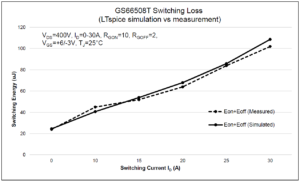
To confirm the accuracy of the LTSpice model, laboratory measurements of GaN E-HEMT switching losses were recorded using a half-bridge, double-pulse test circuit. The switching losses measured in the test were then compared with the LTSpice model simulations. The comparison demonstrates a strong correlation between the simulated results and real-time circuit measurements. With a 400 V, 0 to 30 A switching current setup using a 650 V, 50 milliohm GS65008T device, the difference between actual measurement and the simulated model is less than 5%, a very good number for Eon/Eoff accuracy. The outcome is a simulation tool that provides a convenient and accurate way to understand GaN switching characteristics, evaluate GaN switching performance under different electrical conditions and build overall confidence in a new product design.
Larry Spaziani, GaN Systems VP of Sales and Marketing, commented on the benefits of the LTSpice tool, “By developing and making available for download this full-featured LTSpice simulation tool, GaN Systems has made it easier for power system designers to leverage all the benefits of GaN transistors and to optimize their system performance. Rarely do designers use spice simulation to estimate Eon/Eoff; with our models they can. We expect that this tool will help designers more fully understand GaN technology and accelerate their design completion.”

 

Filed Under: Development Tools Tagged With: gansystems

Reader Interactions

Leave a Reply

You must be logged in to post a comment.

This site uses Akismet to reduce spam. Learn how your comment data is processed.

Primary Sidebar

Featured Contributions

How to design ultra-low-power smart thermostats without a C-wire

Vertical power delivery reduces losses in AI processor designs

Protecting Ethernet interfaces in telecommunications applications against common high energy surges

Ionic cooling: a silent revolution in thermal management

Robust design for Variable Frequency Drives and starters

More Featured Contributions

EE LEARNING CENTER

EE Learning Center

EE TECH TOOLBOX

“ee
Tech Toolbox: Sensors
In this Tech Toolbox, we cover some of those technologies driving the next generation of connected systems, including ultra-low-power sensing strategies that extend node battery life, and 60 GHz CMOS radar for contactless health and presence detection.

EE ENGINEERING TRAINING DAYS

engineering
“power
EXPAND YOUR KNOWLEDGE AND STAY CONNECTED
Get the latest info on technologies, tools and strategies for EE professionals.
“bills

RSS Current EDABoard.com discussions

RSS Current Electro-Tech-Online.com Discussions

  • Momentary SW to Latch and Control IC EN
  • Voltage comparator circuit verification
  • Parasitic Draw Question
  • Why aren’t the power windows in my 2006 Volkswagen Polo 2006 working despite repairing the control unit circuit board?
  • block RF

Footer

EE World Online Network

  • 5G Technology World
  • EE World Online
  • Engineers Garage
  • Analog IC Tips
  • Battery Power Tips
  • Connector Tips
  • EDA Board Forums
  • Electro Tech Online Forums
  • EV Engineering
  • Microcontroller Tips
  • Sensor Tips
  • Test and Measurement Tips

Power Electronic Tips

  • Subscribe to our newsletter
  • Advertise with us
  • Contact us
  • About us

Copyright © 2026 · WTWH Media LLC and its licensors. All rights reserved.
The material on this site may not be reproduced, distributed, transmitted, cached or otherwise used, except with the prior written permission of WTWH Media.

Privacy Policy