• Skip to primary navigation
  • Skip to main content
  • Skip to primary sidebar
  • Skip to footer
  • Subscribe
  • Advertise

Power Electronic Tips

Power Electronic News, Editorial, Video and Resources

  • Products
    • Power Supplies
    • AC-DC
    • DC-DC
    • Battery Management
    • Capacitors
    • Magnetics
    • MOSFETS
    • Power Management
    • RF Power
    • Resistors
    • Transformers
    • Transistors
  • Applications
    • 5G
    • AI
    • Automotive
    • EV Engineering
    • LED Lighting
    • Industrial
    • IoT
    • Wireless
  • Learn
    • eBooks / Tech Tips
    • EE Training Days
    • FAQ
    • Learning Center
    • Tech Toolboxes
    • Webinars & Digital Events
  • Resources
    • Design Guide Library
    • Digital Issues
    • Engineering Diversity & Inclusion
    • LEAP Awards
    • Podcasts
    • White Papers
  • Video
    • EE Videos & Interviews
    • Teardown Videos
  • EE Forums
    • EDABoard.com
    • Electro-Tech-Online.com
  • Engineeering Training Days
  • Newsetter Subscription

SiC MOSFET structure reduces resistance and boosts energy efficiency in power devices

September 5, 2018 By Lee Teschler Leave a Comment

Hitachi Ltd. says it has developed a new kind of silicon-carbide-based MOSFET that has dramatically lower on resistance than comparable devices. The new MOSFET uses what Hitachi calls a TED-MOS structure, for Trench-etched DMOS-FET. Compared to conventional DMOS-FET (Double-diffused MOSFET) devices, the new structure is said to reduce electric field strength, an index of durability by 40% and resistance by 25%. Hitachi expects to the apply the new power devices in motor drives of electric vehicles.

The problem that the new power devices address is that the resistance of a SiC power semiconductor varies greatly depending on the crystal plane. Trench SiC MOSFET structures have been proposed as a way to let current flow on the crystal plane at a lower resistance than in conventional DMOS-FETs. But it has proven to be difficult to come up with a trench structure that is sufficiently durable because electric fields concentrate at the edges of the trench on the base plane, Hitachi says.
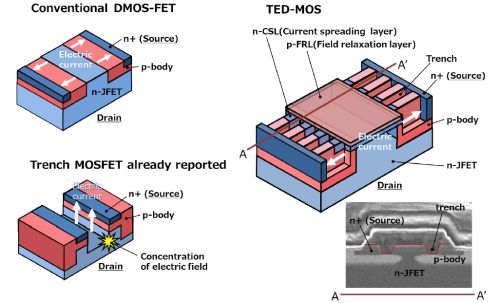
hitachi TED-MOSIn contrast, the new fin-structure DMOS-FET, dubbed TED-MOS, employs a smaller trench pitch to reduce resistance and sees lower electric fields when operating at 3.3 kV. Hitachi uses a field relaxation layer (FRL) to reduce the electric field strength, and a current spreading layer (CSL) to reduce resistance in the n-JFET region. This region serves to form the electric current path connecting the sides fo the fin-like trenches as low-resistance crystal planes and the n-JFET region. Consequently, the device realizes both lower on resistance and electric field strength.

Hitachi prototyped the concept on a device that experienced a electric field strength 40% lower than that of a conventional DMOS-FET and a resistance 25% less. The prototype also had a rated operating voltage of 1.2 kV. Hitachi also reports the prototype saw faster switching speeds which resulted in a 50% improvement in energy loss.

Researchers presented these results at the International Symposium on Power Semiconductor Devices and ICs (ISPSD) in Chicago, and also at the European Conference on Silicon Carbide and Related Materials (ECSCRM) in the UK.
You may also like:


  • Galvanic isolation for electric vehicle systems

  • The benefits of silicon carbide in dc/dc converters
  • tamurasilicon-carbide gate drivers
    A look at IGBT and silicon-carbide gate drivers from Tamura
  • FREEDM center
    Gallery: Cool tech demos at APEC2018, IEEE’s Applied Power Electronics…
  • cascode SiC
    Where SiC outperforms GaN

Filed Under: Featured, MOSFETS, Power Supply News, Promoted features, Semiconductor Tagged With: hitachi

Reader Interactions

Leave a Reply

You must be logged in to post a comment.

This site uses Akismet to reduce spam. Learn how your comment data is processed.

Primary Sidebar

Featured Contributions

How to design ultra-low-power smart thermostats without a C-wire

Vertical power delivery reduces losses in AI processor designs

Protecting Ethernet interfaces in telecommunications applications against common high energy surges

Ionic cooling: a silent revolution in thermal management

Robust design for Variable Frequency Drives and starters

More Featured Contributions

EE LEARNING CENTER

EE Learning Center

EE TECH TOOLBOX

“ee
Tech Toolbox: Sensors
In this Tech Toolbox, we cover some of those technologies driving the next generation of connected systems, including ultra-low-power sensing strategies that extend node battery life, and 60 GHz CMOS radar for contactless health and presence detection.

EE ENGINEERING TRAINING DAYS

engineering
“power
EXPAND YOUR KNOWLEDGE AND STAY CONNECTED
Get the latest info on technologies, tools and strategies for EE professionals.
“bills

RSS Current EDABoard.com discussions

RSS Current Electro-Tech-Online.com Discussions

  • Difference between TTL, RS232 and RS485
  • Beginner Questions About CNC Machines – G-code, Control Systems & Accuracy
  • Smart Buoy project
  • Need Guidance to reduce noise in 3-stage Transimpedance amplifier
  • Wall Radiator Heating: Efficiency and Placement Questions

Footer

EE World Online Network

  • 5G Technology World
  • EE World Online
  • Engineers Garage
  • Analog IC Tips
  • Battery Power Tips
  • Connector Tips
  • EDA Board Forums
  • Electro Tech Online Forums
  • EV Engineering
  • Microcontroller Tips
  • Sensor Tips
  • Test and Measurement Tips

Power Electronic Tips

  • Subscribe to our newsletter
  • Advertise with us
  • Contact us
  • About us

Copyright © 2026 · WTWH Media LLC and its licensors. All rights reserved.
The material on this site may not be reproduced, distributed, transmitted, cached or otherwise used, except with the prior written permission of WTWH Media.

Privacy Policy