• Skip to primary navigation
  • Skip to main content
  • Skip to primary sidebar
  • Skip to footer
  • Subscribe
  • Advertise

Power Electronic Tips

Power Electronic News, Editorial, Video and Resources

  • Products
    • Power Supplies
    • AC-DC
    • DC-DC
    • Battery Management
    • Capacitors
    • Magnetics
    • MOSFETS
    • Power Management
    • RF Power
    • Resistors
    • Transformers
    • Transistors
  • Applications
    • 5G
    • AI
    • Automotive
    • EV Engineering
    • LED Lighting
    • Industrial
    • IoT
    • Wireless
  • Learn
    • eBooks / Tech Tips
    • EE Training Days
    • FAQ
    • Learning Center
    • Tech Toolboxes
    • Webinars & Digital Events
  • Resources
    • Design Guide Library
    • Digital Issues
    • Engineering Diversity & Inclusion
    • LEAP Awards
    • Podcasts
    • White Papers
  • Video
    • EE Videos & Interviews
    • Teardown Videos
  • EE Forums
    • EDABoard.com
    • Electro-Tech-Online.com
  • Engineeering Training Days
  • Newsetter Subscription

Researchers coat linen thread with nanotubes to make thread-based transistors

August 22, 2019 By Lee Teschler Leave a Comment

In a study published in ACS Applied Materials and Interfaces, researchers from Tufts University say they have devised the first thread-based transistors (TBTs) which can be fashioned into simple, all-thread based logic circuits and integrated circuits.
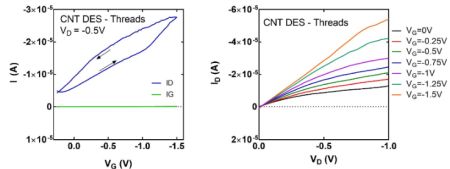
TBT characteristic curves
Transfer (left) and output curves of a carbon nanotube deep eutectic solvent gel TBT.
The Tufts devices work in a way that is analogous to an FET. Making a TBT involves coating a linen thread with carbon nanotubes. This creates a semiconductor surface through which electrons can travel. Attached to the thread are two thin gold wires — the source and the drain. (In some configurations, the electrons can flow in the other direction.) A third wire, the gate, is attached to material surrounding the thread such that small changes in voltage through the gate wire allows a large current to flow through the thread between the source and drain.

A critical innovation in this study is the use of an electrolyte-infused gel as the material surrounding the thread and connected to the gate wire. In this case, the gel is made up of silica nanoparticles that self-assemble into a network structure. The electrolyte gel (or ionogel) can be easily deposited onto the thread by dip coating or rapid swabbing. In contrast to the solid-state oxides or polymers used as gate material in classical FETs, the ionogel is resilient under stretching or flexing.

Tufts researchers interconnect TBTs with thread-based electrochemical sensors (TBEs) to realize an all-thread-based multiplexed diagnostic device. All-thread based platforms are thin, highly flexible and conformal, allowing them to be worn directly on the skin without any polymeric substrate, or sutured transdermally using a needle.
Compared to electronics based on polymers and other flexible materials, thread-based electronics have better flexibility, material diversity, and the ability to be manufactured without the need for cleanrooms, the researchers say. The thread-based electronics can include diagnostic devices that are extremely thin, soft and flexible enough to integrate seamlessly with the biological tissues that they are measuring.

The Tufts engineers previously developed a suite of thread-based temperature, glucose, strain, and optical sensors, as well as microfluidic threads that can draw in samples from, or dispense drugs to, the surrounding tissue. The thread-based transistors developed in this study allow the creation of logic circuits that control the behavior and response of those components. The authors created a simple small-scale multiplexer (MUX) and connected it to a thread-based sensor array capable of detecting sodium and ammonium ions — important biomarkers for cardiovascular health, liver and kidney function.

“In laboratory experiments, we were able to show how our device could monitor changes in sodium and ammonium concentrations at multiple locations,” said Rachel Owyeung, a graduate student at Tufts University School of Engineering and first author of the study. “Theoretically, we could scale up the integrated circuit we made from the TBTs to attach a large array of sensors tracking many biomarkers, at many different locations using one device.”

Said Sameer Sonkusale, professor of electrical and computer engineering at Tufts University School of Engineering and corresponding author of the study, “There are many medical applications in which real-time measurement of biomarkers can be important for treating disease and monitoring the health of patients. The ability to fully integrate a soft and pliable diagnostic monitoring device that the patient hardly notices could be quite powerful.”

You may also like:


  • New from the research lab: High-energy textile lithium battery
  • Wireless battery-charger
    Wireless battery-charger dev kit for small IoT devices
  • wireless charging
    Wireless charging in vehicles — making the cables disappear

  • Longer battery life for hearables and wearables

Filed Under: Featured, Promoted features Tagged With: MOSFETs

Reader Interactions

Leave a Reply

You must be logged in to post a comment.

This site uses Akismet to reduce spam. Learn how your comment data is processed.

Primary Sidebar

Featured Contributions

Vertical power delivery reduces losses in AI processor designs

Protecting Ethernet interfaces in telecommunications applications against common high energy surges

Ionic cooling: a silent revolution in thermal management

Robust design for Variable Frequency Drives and starters

Meeting demand for hidden wearables via Schottky rectifiers

More Featured Contributions

EE LEARNING CENTER

EE Learning Center

EE TECH TOOLBOX

“ee
Tech Toolbox: Aerospace & Defense
This Tech Toolbox dives into the technical realities of modern defense, exploring how MBSE is streamlining aerospace design and what’s next for radar and electronic warfare.

EE ENGINEERING TRAINING DAYS

engineering
“power
EXPAND YOUR KNOWLEDGE AND STAY CONNECTED
Get the latest info on technologies, tools and strategies for EE professionals.
“bills

RSS Current EDABoard.com discussions

RSS Current Electro-Tech-Online.com Discussions

  • EasyEda program has a major bug
  • PCB manufacturing issues
  • Convenient audio FFT module?
  • Mystery amp noise - ??
  • SDCC Array Access In Timer 0 Interrupt Handler

Footer

EE World Online Network

  • 5G Technology World
  • EE World Online
  • Engineers Garage
  • Analog IC Tips
  • Battery Power Tips
  • Connector Tips
  • EDA Board Forums
  • Electro Tech Online Forums
  • EV Engineering
  • Microcontroller Tips
  • Sensor Tips
  • Test and Measurement Tips

Power Electronic Tips

  • Subscribe to our newsletter
  • Advertise with us
  • Contact us
  • About us

Copyright © 2026 · WTWH Media LLC and its licensors. All rights reserved.
The material on this site may not be reproduced, distributed, transmitted, cached or otherwise used, except with the prior written permission of WTWH Media.

Privacy Policy