• Skip to primary navigation
  • Skip to main content
  • Skip to primary sidebar
  • Skip to footer
  • Subscribe
  • Advertise

Power Electronic Tips

Power Electronic News, Editorial, Video and Resources

  • Products
    • Power Supplies
    • AC-DC
    • DC-DC
    • Battery Management
    • Capacitors
    • Magnetics
    • MOSFETS
    • Power Management
    • RF Power
    • Resistors
    • Transformers
    • Transistors
  • Applications
    • 5G
    • AI
    • Automotive
    • EV Engineering
    • LED Lighting
    • Industrial
    • IoT
    • Wireless
  • Learn
    • eBooks / Tech Tips
    • EE Training Days
    • FAQ
    • Learning Center
    • Tech Toolboxes
    • Webinars & Digital Events
  • Resources
    • Design Guide Library
    • Digital Issues
    • Engineering Diversity & Inclusion
    • LEAP Awards
    • Podcasts
    • White Papers
  • Video
    • EE Videos & Interviews
    • Teardown Videos
  • EE Forums
    • EDABoard.com
    • Electro-Tech-Online.com
  • Engineeering Training Days
  • Newsetter Subscription

Fast-recovery epitaxial diodes support higher current applications

December 15, 2021 By Lee Teschler Leave a Comment

A line of fast recovery epitaxial diodes called the PUUPxxH family extends the benefits of FRED technology to applications requiring up to 6 A of operating current. These high-reliability (AEC-Q101 qualified) devices deliver optimized switching speed vs. reverse recovery time. Their soft reverse recovery results in lower noise switching while achieving low losses and increased efficiency. The TO-227 package heat spreader contacts provide excellent heat transfer.

In addition to the 100 and 200-V-rated 3, 4 and 6-A models in the PUUP series, 3 and 4-A versions are available in SOD-128 and DO-214 packages. “The taiwan semiconductornew PUUP series’ FRED technology delivers increasing efficiency and power density in switching power applications in newer more thermally advantageous packaging,” said Vice President, TSC Products, Sam Wang. “And for instant upgrade to the benefits of this technology, 3A and 4A versions are also
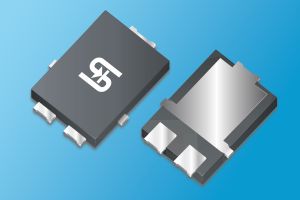
offered in historical packaging.”

The new additions to the TSC FRED series provide several beneficial features:
•Fast Switching and Reverse Recovery Times – Increases efficiency in a wide range of power electronics designs from medium voltage to high voltage applications, lowers EMI and RFI and simplifies snubber and filtering design.
•Low Reverse Leakage – Industry-leading maximum IR (1 µA @ T j =25°C) improves efficiency and offers a more controlled switching response between forward and reverse conduction modes.
•Low Reverse Recovery Charge –Maximum QRR (40 nC @ IF =0.5 A, IR =1.0 A, IRR =0.25 A) lowers parasitic ringing and EMC, reduces the need for snubbers; increases switching speed and lowers losses.
•AEC-Q Automotive Qualified – 175°C T j(max) compelling for automotive and industrial applications –Production Part Approval Process (PPAP) documentation is available.
•Global Materials Compliance – RoHS compliant, halogen-free (per IEC-61249-2-21), WEEE, REACH, California Prop. 65, JESD-201 Class 2 Whisker Test and others.
•Thermally Advantageous TO-227 Package – Ideal for automated placement. Low profile packaging with heat-spreader contacts provides excellent thermal management.

Applications include switching power conversion in automotive, lighting, industrial and communications. Specific applications benefiting from AEC-Q qualification include fuel injection systems, electrification of transportation and automated navigation. Design resources include comprehensive datasheets and spice models for each component in the series. Price: From $0.40 in OEM Quantities. Lead Time: Samples: in-stock (Digi-Key and Mouser).

Taiwan Semiconductor, 2851 Junction Avenue, San Jose, CA 95134, 1-408-3828000, FAX: 1-408-3828008, www.taiwansemi.com


You may also like:

  • talk of battery fires still smolders
    Talk of EV fires still smolders
  • charging
    Say goodbye to cross-country road trips
  • battery breakthrough fatigue
    Battery breakthrough fatigue
  • electrolytic caps
    Why electrolytic capacitors blow up
  • safety first
    How to electrocute yourself in a few easy steps

Filed Under: diodes, Power Components Tagged With: taiwansemiconductorcoltd

Reader Interactions

Leave a Reply

You must be logged in to post a comment.

This site uses Akismet to reduce spam. Learn how your comment data is processed.

Primary Sidebar

Featured Contributions

Vertical power delivery reduces losses in AI processor designs

Protecting Ethernet interfaces in telecommunications applications against common high energy surges

Ionic cooling: a silent revolution in thermal management

Robust design for Variable Frequency Drives and starters

Meeting demand for hidden wearables via Schottky rectifiers

More Featured Contributions

EE LEARNING CENTER

EE Learning Center

EE TECH TOOLBOX

“ee
Tech Toolbox: Aerospace & Defense
This Tech Toolbox dives into the technical realities of modern defense, exploring how MBSE is streamlining aerospace design and what’s next for radar and electronic warfare.

EE ENGINEERING TRAINING DAYS

engineering
“power
EXPAND YOUR KNOWLEDGE AND STAY CONNECTED
Get the latest info on technologies, tools and strategies for EE professionals.
“bills

RSS Current EDABoard.com discussions

RSS Current Electro-Tech-Online.com Discussions

  • EasyEda program has a major bug
  • PCB manufacturing issues
  • Convenient audio FFT module?
  • Mystery amp noise - ??
  • SDCC Array Access In Timer 0 Interrupt Handler

Footer

EE World Online Network

  • 5G Technology World
  • EE World Online
  • Engineers Garage
  • Analog IC Tips
  • Battery Power Tips
  • Connector Tips
  • EDA Board Forums
  • Electro Tech Online Forums
  • EV Engineering
  • Microcontroller Tips
  • Sensor Tips
  • Test and Measurement Tips

Power Electronic Tips

  • Subscribe to our newsletter
  • Advertise with us
  • Contact us
  • About us

Copyright © 2026 · WTWH Media LLC and its licensors. All rights reserved.
The material on this site may not be reproduced, distributed, transmitted, cached or otherwise used, except with the prior written permission of WTWH Media.

Privacy Policy