
The new DL-ISO High Voltage Optically Isolated 1-GHz Probe and Power-Device test software, when combined with LeCroy High Definition Oscilloscopes (HDO), are said to offer the most accurate electrical characterization of gallium nitride (GaN) and silicon carbide (SiC) power semiconductor devices.
For more than thirty years, engineers have used silicon (Si) metal-oxide-semiconductor field-effect transistor (MOSFET) and insulated-gate 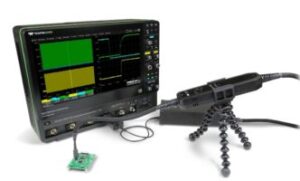 bipolar transistor (IGBT) power semiconductor devices to produce power supplies and power conversion systems. However, consumers are demanding smaller and lighter power supplies and systems, and governments are mandating higher efficiencies. Wide-bandgap (WBG) materials, such as GaN and SiC, switch more than ten times faster than Si in semiconductor devices, and reduce size and weight while increasing efficiency. However, many engineers are implementing WBG semiconductors for the first time, and they need more measurement bandwidth and more accurate and detailed analysis of the semiconductor devices.
The new Teledyne LeCroy DL-ISO High Voltage Optically Isolated Probe provides design engineers with the highest-confidence GaN and SiC power semiconductor device measurements. The new probe has the best signal fidelity, lowest overshoot and best accuracy — 1.5% when combined with Teledyne LeCroy’s industry-leading 12-bit resolution HDOs, nearly twice as good as the only competitor. The 1-GHz bandwidth meets requirements to measure GaN device 1-nsec rise times. HDOs also provide up to 20 GS/sec sample rate at 12-bit resolution for the most faithful capture and display of high-speed GaN and SiC device signals. This combination of best signal fidelity, low overshoot, high accuracy, high bandwidth and high sample rate is critically important for successfully implementing GaN and SiC technologies in new designs. Teledyne LeCroy’s new Power-Device software package additionally simplifies the analysis of GaN and SiC devices with automated JEDEC® switching loss and other measurements, and color-coded overlays to highlight the relevant, measured areas.
The DL-ISO probes are offered in bandwidths of 350 MHz, 700 MHz and 1 GHz. Availability of the probe and Power-Device software is 14 weeks ARO.
Compatible Teledyne LeCroy HDOs range in bandwidth from 350 MHz to 8 GHz, with 12-bit resolution all the time and up to 20 GS/sec sample rate.
Teledyne LeCroy, 700 Chestnut Ridge Road, Chestnut Ridge, NY 10977-6499, 800-553-2769 or 845-425-2000, Fax Sales: 845-578-5985, contact.corp@teledynelecroy.com, support@teledynelecroy.com, teledynelecroy.com/powerprobes




Leave a Reply