
Despite the convenience and availability of LEDs, the neon lamp still has a viable position as a power-on indicator as well as use in some specialty applications.
Thus far, we have looked basic neon lamp principles and operation. This part looks at some special issues related to these versatile indicators.
Q: Why use a neon lamp when LEDs are so available, efficient, and inexpensive?
A: The reason is simple: it’s almost trivial to drive a neon lamp from an AC line as a “power-on” indicator, such as used for a power strip or chassis of a line-operated unit; all it requires is the lamp and the series resistor (and you can buy neon lamps with the resistor built-in). In contrast, driving an LED requires a low voltage DC source, which, in turn, means some sort of AC/DC circuit with more cost complexity (Figure 1).
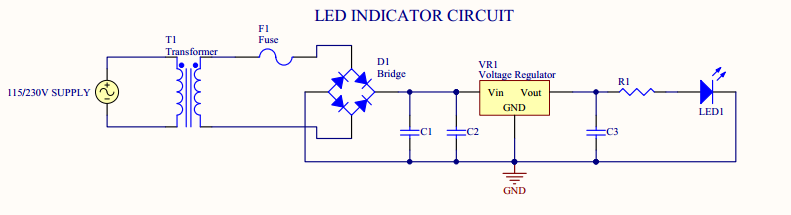
Q: Wait, aren’t there ways to directly drive an LED from the AC mains with the need for a transformer, rectifying diode, or DC/DC regulator?
A: Yes, there are. But they still involve more components and have some implementation issues that may impede regulatory safety approvals.
Q: What are some of these AC-to-LED circuits?
A: Among the possibilities is the “capacitor-dropper” (cap-drop) supply which is used in some commercial designs when a low-current DC rail is needed from an AC source. As such, it could be used for driving an LED instead of a neon lamp (Figure 2).
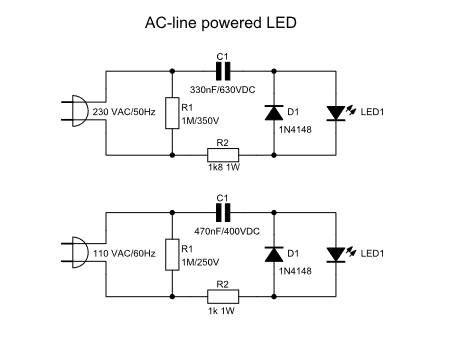
But the circuit clearly requires many more components than the neon-lamp circuit and is not galvanically isolated from the AC line, so there are associated safety issues to resolve. Further, the circuit and LED indicator may mislead, as a failure of any of the intermediary components would keep the AC-indicator LED dark even if AC was present. In contrast, the neon lamp is connected directly to the power line with only that intervening resistor, so it is a reliable and consistent indicator of AC line presence.
Q: What’s the history of neon lamps?
The history of discharge lamps in general and neon lamps, in particular, is well known and documented. In brief, it’s a very old technology: the glow lamp we know today in the form of a small glass bulb was patented in 1919 (US patent 1316967), but gas-discharge tubes were known long before that date. Geissler tubes, an early form of gas-discharge tubes, for example, were invented in 1857. The External References link to credible historical sources.
Q: What else can you do with neon lamps?
A: Many non-illumination things have been done:
- Line-voltage tester: if the neon lamp has a striking voltage of 50-90 VAC, it can be used in a plug-in unit to test if an outlet is live. This is used in many commercial testers.
- Neon lamps are commonly used as low-voltage surge protectors, similar to gas-discharge (GDT) tube surge protectors for higher voltage applications). They are an inexpensive method to protect RF receivers from voltage spikes, with the lamp connected between RF input and chassis ground. They can also be used in low-cost, homemade lighting-detector circuits.
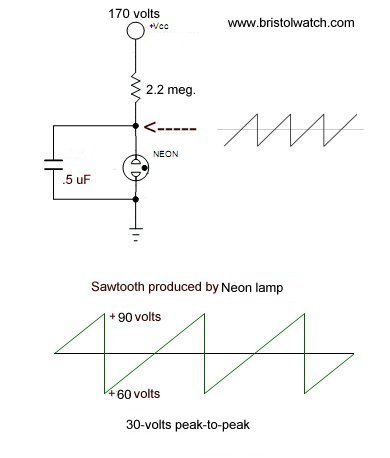
- They can be used as circuit-switching elements due to their negative-resistance characteristic, as so be the basis for relaxation oscillators for low-frequency, sawtooth-wave applications such as flashing warning lights, stroboscopes, tone generators in electronic organs, and as time bases and deflection oscillators in early oscilloscopes based on the cathode ray tube (CRT) (Figure 3).
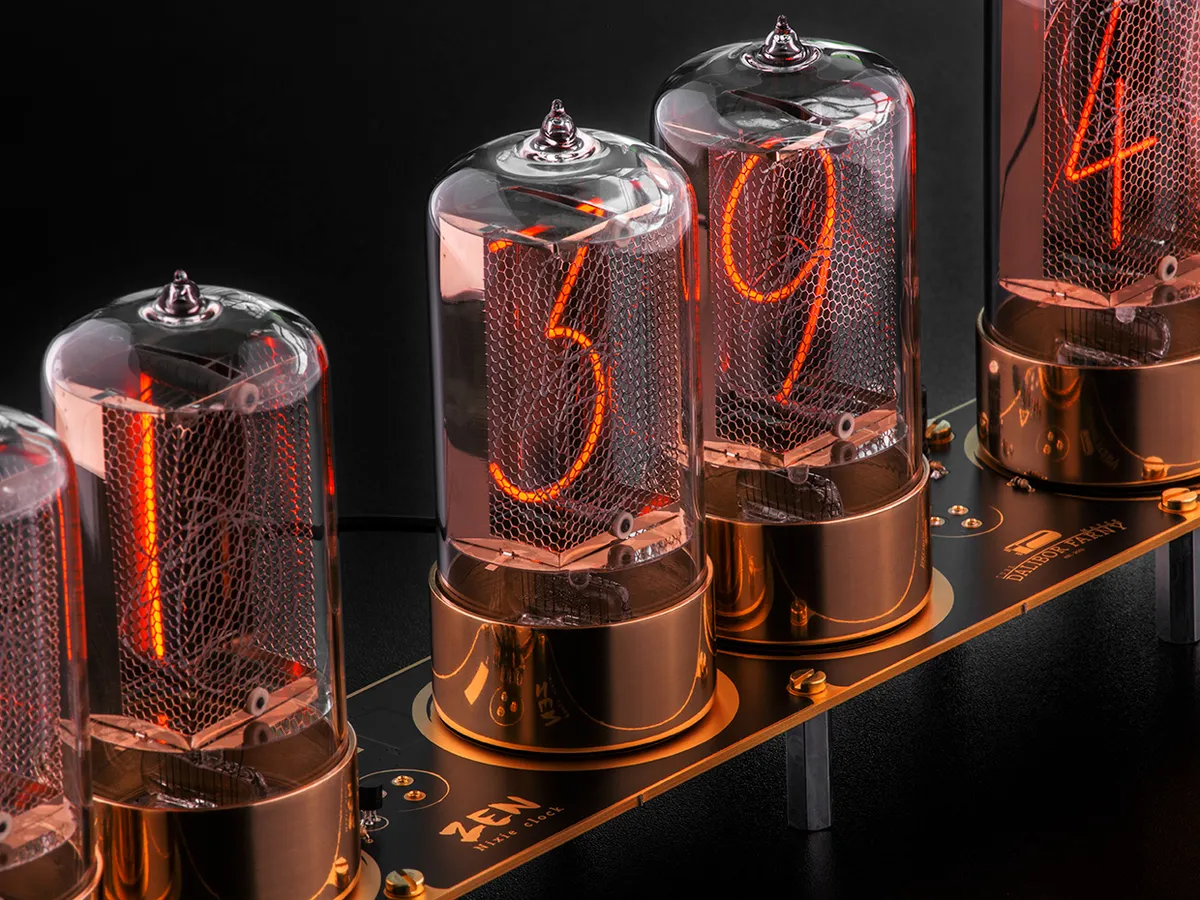
- The basic indicator can be fashioned into a glowing Nixie tube used for numeric readout, widely used before the availability of seven-segment displays (Figure 4). A group of such tubes was often used as the digital readout in instrumentation such as digital voltmeters. Although they are obsolete, a large enthusiast market still uses them – if you can find them somehow – in personal projects.
- Finally, they were used to build logic gates, again due to the switching action of the negative-resistance characteristic. There were even commercial computers based on neon-indicator lamps; these obviously were superseded by our present solid-state gates and ICs.
Q: I want to experiment with and explore neon lamps. Where do I start?
A: There are dozens of websites – hobbyist and commercial – which look at basic neon-lamp circuits and setups. Most involve the NE-2 neon lamp, the most widely used basic indicator available from many vendors and distributed; the cost is 25 to 50 cents depending on volume (Figure 5).
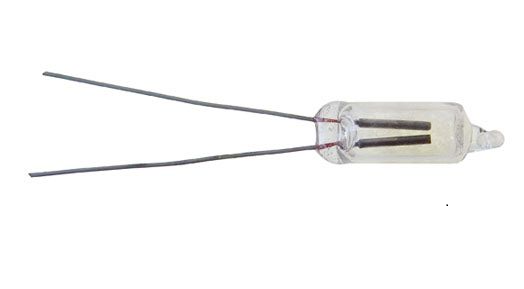
The NE-2 neon lamp is a “classic” component; it’s in a select group that includes devices such as the 2N2222 and 2N3904 transistors, 741 op amp, and 555 timer IC: all widely used, widely available, and offered in many generic versions, and have never gone out of style despite its age. The standard NE-2 indicator lamp with wire leads measures 5.0 mm × 12 mm, operates from 65 VAC to 120 VAC, has a 0.3 mA forward-current rating, and comes in a basic model as well as many variants.
Q: What about neon and related discharge signs?
A: That’s another topic with different imperatives, constraints, and construction issues. The External References provide interesting insight into the topic.
The neon lamp shows that even as new technologies arise and “take over,” there are still situations where older technologies – even much older ones – still have a viable role. In some cases, they remain the best choice for addressing and solving a design challenge due to their unique combination of attributes and performance.
EE World Related Content
Small LED Indicator For Thick Panels
High Voltage Industrial LED Panel Indicators
New 14-mm panel LED indicator light designed for rugged industrial use
Robust LED panel mount indicator series for frequent On/Off cycling
External References
Technical and DIY
- Wikipedia, “Neon lamp” (basic reference)
- Wikiwand, “Neon lamp” (technical with extensive references)
- YouTube, “Lighting the Neon Bulb” (basic hands-on project)
- ch, “Neon glow lamps: more than simple light sources” (lots of DIY projects)
- Hackaday, “The Humble NE-2 Neon Lamp Has A New Trick” (DIY projects)
- Bristol Watch, “Neon NE-2 Circuits You Can Build” (DIY projects)
- Homemade Circuit Projects, “Neon Lamps – Working and Application Circuits” (DIY projects)
- International Light Technologies, Inc., “Neon Lamps: Application & Technical Notes” (technical and applications)
- Data Sheet Archive, “Chicago Miniature NE-2 Datasheet” (detailed data sheet)
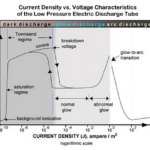
- Thunderbolts Project, “V-J-characteristics-discharge-tube-JJ” (Discharge tube graph)
- ThoughtCo-DotDash/Meredith, “How Neon Lights Work (A Simple Explanation)”
- EGL-Neon, “Dispelling the “Inefficient Neon” Myth”
History
- ThoughtCo-DotDash/Meredith, “The History of Neon Signs” (history)
- Hackaday, “The History Of Neon Lights” (history)
- Will Moneymaker, “A Brief History of Neon Lighting” (history)
- Science History Institute “A Blaze of Crimson Light: The Story of Neon” (history)
- Neon Library, “Neon History” (history)
- Yellowpop, “A Brief History of Neon Signs” (history)
Neon signs
- Vida Signs, “Everything to know about Neon Signs: Power Consumption, Usage and much more”
- YouTube, “How Neon Signs Are Made for Restaurants — How to Make It”
- YouTube, “Neon Williams: Boston’s Last Neon Sign Shop”
- YouTube, “Here’s the science behind neon signs”
- Wikipedia, “Neon Sign”
- Tech Times LLC, “Revolutionizing Outdated Tech – LED Neon Signs”
- American Sign Museum
- NeonPlus, “Neon signs—how they work, how they perform and are there alternatives?”
- Wikipedia, “Neon Lighting”
LED on AC line
- Turbokeu, “AC-powered LED “
- ElecCircuit, “Many Simple LED AC mains voltage & current indicator circuits”
- Hobby Circuits, “AC Line powered LEDs”
Other
- EDN, “Cap-Drop Supply: Odd, Interesting, Useful… and Somewhat Dangerous”
- IEEE Spectrum, “The Nixie Tube Story: The Neon Display Tech That Engineers Can’t Quit”

good article. You did not mention, common use: strobe light for Turntable speed since it flickers at the line rate. Pro turntables with pitch control have them built in.