
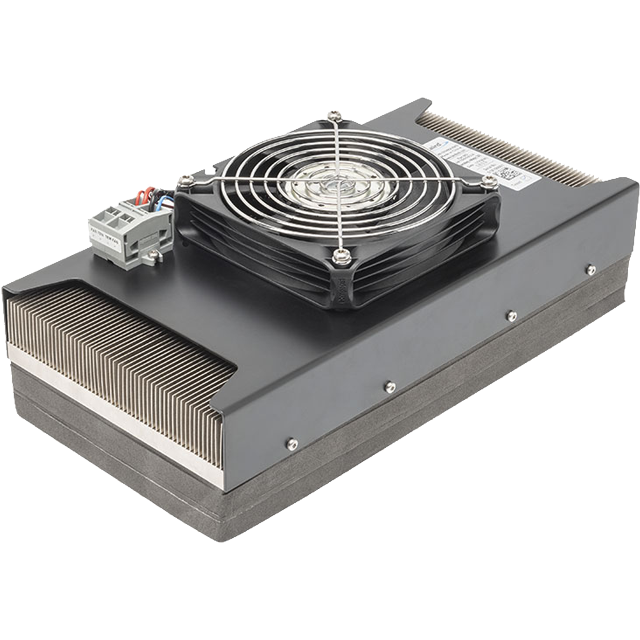
 Incubators are used for cell and tissue cultivation in hospital and laboratory settings. Accurate and precise control of temperature is important for cell growth, as excursions above or below the optimum mammalian body temperature of 37°C, by as little as 6°C, negatively impacts cell health and growth. Environmentally friendly SuperCool Peltier temperature control systems and programmable temperature controllers from Laird Thermal Systems offer an alternative to compressor-based systems in a smaller package for heating and cooling inside the incubator chamber.
Recent government regulations on the use of traditional and natural refrigerants critical to compressor-based systems make Peltier thermoelectrics an appealing alternative for incubator temperature stabilization. The compact SuperCool Series thermoelectric assemblies do not use refrigerants. Instead, they feature a unique hot side air heat sink design that dissipates heat more efficiently than traditional heat exchanger technologies. Utilizing optimized thermoelectric modules in combination with a high-performance heat sink and fan shroud assembly, the SuperCool thermoelectric assembly transfers heat-to-air more rapidly using up to 60% less power. In addition, the Peltier thermoelectric assembly has a solid-state construction that provides years of maintenance-free operation.
The SuperCool Series is available in three models to provide heat transfer mechanism options on the control side. Heat can be absorbed via liquid, conduction or convection. The Liquid-to-Air unit has a cooling capacity of 202 Watts, while the Direct-to-Air offers 193 Watts and the Air-to-Air provides 166 Watts.
Combining a SuperCool thermoelectric assemblies with a temperature controller offers significant design advantages over traditional technologies. The SR-54 programmable microcontroller provides thermal stability to within ±0.13°C of the set point in both heating and cooling modes. Its monitoring capabilities track potential issues, including problematic fans, thermoelectric modules, and thermostats for quick fault troubleshooting, maximizing incubator uptime. Variable fan speed reduces operational noise and lowers power consumption.
The PR-59 temperature controller is customizable and user-configurable with easy-to-use software from Laird Thermal Systems. In addition to temperature control, users can set additional parameters for fans, NTC thermistors, PT1000 sensors, alarm and LEDs
Laird Thermal Systems has the design, prototyping, testing and global manufacturing services to help integrate thermoelectric cooling into incubation applications. Our engineers partner closely with customers throughout the entire product development lifecycle to reduce risks and accelerate time-to-market for emerging applications.


Leave a Reply