
Fans of the sci-fi franchise Star Trek may recall a scene in the 1986 film Star Trek IV: The Voyage Home that mentions a make-believe material called transparent aluminum. A real-world version of it eventually emerged from Oxford University where researchers created a ceramic alloy (officially called Aluminum Oxynitride or ALON) by fusing aluminum, oxygen and nitrogen, then gave it the unofficial moniker used in the Star Trek flim. But ALON remained too expensive for practical use.
But a recent development at the University of Michigan may bring a transparent version of a normally opaque material that does indeed have practical applications. Researchers there say they’ve created the thinnest, smoothest layer of silver that can survive air exposure, and it could change the way touchscreens and flat or flexible displays are made.
The trick is in combining the silver with a little bit of aluminum. The result is a thin metal layer that is up to 92.4% transparent.
Touchscreens could comprise a mainstream use for transparent silver as a replacement for indium tin oxide, the material now widely used as a touchscreen conductor. ITO is projected to become expensive as demand for touch screens continues to grow; there are relatively few known sources of indium, says U of M researcher L. Jay Guo.
Usually, it’s impossible to make a continuous layer of silver less than 15-nm thick, roughly corresponding to the diameter of 100 silver atoms. Silver has a tendency to cluster together in small islands rather than extend into an even coating, Guo said.
By adding about 6% aluminum, the researchers coaxed the metal into a film of less than half that thickness—seven nanometers. What’s more, when they exposed it to air, it didn’t immediately tarnish as pure silver films do. After several months, the film maintained its conductive properties and transparency. And it was firmly stuck on, whereas pure silver comes off glass with Scotch tape.
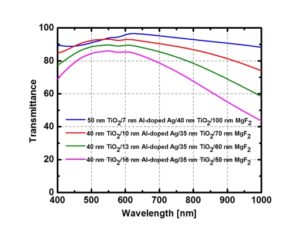
Researchers say one way to increase the transmittance (reduce reflection) of a thin-metal film is to employ a dielectric-metal-dielectric (DMD) structure. There’s more light transmittance and fewer internal reflections because of multiple optical resonances within the dielectric layers. Transmittance is enhanced (reflection is suppressed) by the resonances within the dielectrics. The closely spaced multiple resonances contribute to the broadband enhancement of the transmission.
The DMD design also works with thicker silver films. But as you might expect, increased absorption associated with thicker metal films reduces light transmission. For a 10-nm Al-doped Ag film, the optimized structure of 40 nm TiO2/10-nm Al-doped Ag/35-nm TiO2/70-nm MgF2 gives out an averaged transmittance of 87.4% from 400 nm to 1000 nm. The transmission is even lower for structures with 13-nm and 16-nm Al-doped Ag films (averaged transmittance of 80.1% and 71.7% respectively).
The thin silver films may also find use as light guides thanks to silver’s unparalleled ability to transport visible and infrared light waves along its surface. The light waves shrink and travel as so-called surface plasmon polaritons, showing up as oscillations in the concentration of electrons on the silver’s surface.
Those oscillations encode the frequency of the light, preserving it so that it can emerge on the other side. While optical fibers can’t scale down to the size of copper wires on today’s computer chips, plasmonic waveguides could allow information to travel in optical rather than electronic form for faster data transfer. As a waveguide, the smooth silver film could transport the surface plasmons over a centimeter—enough to get by inside a computer chip.
The researchers described their work in a paper titled “High-performance Doped Silver Films: Overcoming Fundamental Material Limits for Nanophotonic Applications” published in the journal Advanced Materials. The first author is Cheng Zhang, a recent U-M doctoral graduate in electrical engineering and computer science. U-M has applied for a patent and is seeking partners to bring the technology to market.

Leave a Reply