
Author: Rutronik Electronics staff
As supercapacitors, or electric double-layer capacitors (EDLCs), become more and more widely used, they are increasingly looked at as replacements for batteries. However, in many cases a 1:1 exchange is impractical or even impossible. Nevertheless, supercaps have their place.
Batteries and supercaps are based on completely different energy storage methods. Looking at them more closely, it becomes clear why they cannot be simply interchanged:
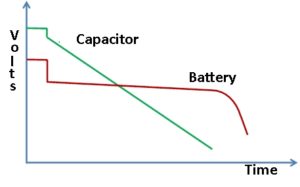
A battery is, in practice, a voltage source. The voltage remains stable during discharge over a wide range of load currents and only drops sharply at the end of the discharge process. During battery charging, the electrical energy is converted into chemical energy and is stored as such. On discharge, it is released again as electrical energy. The stored energy is calculated by the equation:
E = (C/3,600)V
where E = energy, watt-sec; C = battery capacity, Ah; 3,600 is a conversion factor, sec; and V = nominal voltage. Depending on the battery technology, energy conversion attains an efficiency of approximately 50 to 90%.
Batteries offer the advantage over capacitors of much higher energy content. Their disadvantages are sensitivity to high current peaks, which permanently damage the battery, and an operating temperature range limited to approximately 0 to 45°C. Values above or below those limits will shorten the life of the battery owing to its chemical composition.
On the other hand, capacitors store energy in electrostatic form, and the voltage drop as current flows is essentially linear. Thus, they are classed as a current-based power source.
 They attain an efficiency of around 98% and operate without damage within a temperature range from -40 to + 65°C; at low temperatures their capacity even increases a little. Thanks to an ESR (equivalent series resistance) in the milliohm range, current peaks of several hundred to a thousand amperes are possible. Their Achilles heel is their much lower energy content compared to batteries. The energy content is calculated by the equation:
W = 0.5(C x ∆V²)
where W = maximum stored energy content, watt-hr; C = total supercap energy capacity, watt-hr; and ∆V = voltage swing from Vmin to Vmax.
To migrate a power supply from batteries to EDLCs, the energy storage device must be fundamentally resized owing to the different technologies and qualities. Starting with the battery rating is not normally useful, as batteries are often over-dimensioned to withstand the necessary current and power output peaks. Such over-dimensioning is not necessary for EDLCs because of their peak current withstand capability.
Anyone looking to switch from batteries to capacitors should answer the primary question of how much power is needed – that is to say, the operating and buffer times that are desirable or necessary, and at what current, potential voltage swing, and power output.
Recall that effective EDLC energy storage is a function of the voltage swing. With smaller voltage swings, it takes more capacity for the same power output. A dc/dc converter may need to be added to provide the required voltage range.
It is often the case that engineers who evaluate applications strictly from the standpoint of energy storage conclude that a scheme based purely capacitors is not useful. But often the answer to the battery-or-capacitor question is “a combination of the two.”
With a hybrid approach of this kind, the battery capacity serves to lengthen the operating time per charge. Simultaneously, thanks to the lower current load, the battery life lengthens substantially, perhaps by as much as 100%. The hybrid approach can be implemented via various topologies, from a simple parallel configuration to actively controlled and logically linked systems.
The practical example of a 14.4-V cordless screwdriver illustrates the performance of schemes featuring EDLCs alone, lithium-ion batteries alone, and combinations of the two in terms of charging time, power, and operating time.
At present, cordless screwdrivers mostly use lithium-ion batteries. These cells are lighter and have much higher capacity than their predecessors, NiCd and NiMh batteries.
In one practical test, a cordless screwdriver worked from five series-configured 350F EDLC cells charged to 13.8 V. The tool could screw approximately 40 wood screws (4.5 x 40 mm) into a board before recharging. At 20-A charging current, the capacitors fully recharged in about 35 seconds. There were no charging electronics required, just a charging end voltage limiter.
An advantage of this approach is that no low voltage cut-out is needed, as there is still sufficient torque available even as the rotation speed slows. This is because EDLCs are able to deliver many times the current available from batteries and can also withstand low voltages without damage. They permit over 100,000 recharging cycles.
When the cordless screwdriver operated from a lithium-ion battery with 1.5-Ah nominal capacity, the tool was able to screw approximately 250 wood screws of the same size into the same wood board on a single charge. It then took about an hour to fully recharge the battery.
It should be noted that all higher-quality cordless screwdrivers have a low voltage cut-out to protect the battery. The depth of discharge (DOD) of a lithium-ion battery is approximately 70%, meaning that of the 1.5 Ah capacity, only 1.05 Ah is actually available. If the battery discharges beyond that, there could be lasting damage. As the battery life progresses the usable nominal capacity drops further. In practice, the battery can withstand between 150 and 200 charging cycles.
In the hybrid solution, the 1.5-Ah lithium-ion battery was paired with 15 25F EDLCs. The cordless screwdriver was then able to screw approximately 300 of the wood screws into the board. The recharging time with this approach, too, was about one hour, but the battery life was doubled to around 400 charging cycles, and the DOD improved to between 80 to 90%.
Thus the lithium-ion/EDLC combo delivered the best performance with the same charging time as in a screwdriver powered purely by batteries. But there was an added bonus of double the battery life and a higher DOD, giving a higher energy yield per discharge. So this technology holds promise for battery-powered equipment such as power tools.

This is really informative post. I love this.