• Skip to primary navigation
  • Skip to main content
  • Skip to primary sidebar
  • Skip to footer
  • Subscribe
  • Advertise

Power Electronic Tips

Power Electronic News, Editorial, Video and Resources

  • Products
    • Power Supplies
    • AC-DC
    • DC-DC
    • Battery Management
    • Capacitors
    • Magnetics
    • MOSFETS
    • Power Management
    • RF Power
    • Resistors
    • Transformers
    • Transistors
  • Applications
    • 5G
    • AI
    • Automotive
    • EV Engineering
    • LED Lighting
    • Industrial
    • IoT
    • Wireless
  • Learn
    • eBooks / Tech Tips
    • EE Training Days
    • FAQ
    • Learning Center
    • Tech Toolboxes
    • Webinars & Digital Events
  • Resources
    • Design Guide Library
    • Digital Issues
    • Engineering Diversity & Inclusion
    • LEAP Awards
    • Podcasts
    • White Papers
  • Video
    • EE Videos & Interviews
    • Teardown Videos
  • EE Forums
    • EDABoard.com
    • Electro-Tech-Online.com
  • Engineeering Training Days
  • Newsetter Subscription

Want to kill Covid? 30 sec under 285-nm UV-LEDs will do it

December 15, 2020 By Lee Teschler 1 Comment

Researchers from Tel Aviv University found that UV light at a wavelength of 285 nm was almost as efficient in disinfecting the Covid virus as a wavelength of 265 nm, requiring less than half a minute to destroy more than 99.9% of the coronaviruses. They say this result is significant because the cost of 285-nm LED bulbs is much lower than that of 265-nm bulbs, and the former are also more readily available.

The study led by Prof. Hadas Mamane, Head of the TAU School of Mechanical Engineering’s Environmental Engineering Program, is said to be the first conducted on the disinfection efficiency of UV-LED irradiation at different wavelengths or frequencies on a virus from the family of coronaviruses. The results were published in the Nov. 2020 issue of the Journal of Photochemistry and Photobiology B: Biology.

“We discovered that it is quite simple to kill the coronavirus using LED bulbs that radiate ultraviolet light,” Mamane explained. “We killed the viruses using cheaper and more readily available LED bulbs, which consume little energy and do not contain mercury like regular bulbs. Our research has commercial and societal implications, given the possibility of using such LED bulbs in all areas of our lives, safely and quickly.”
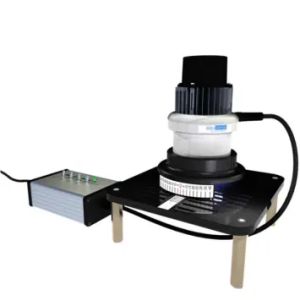
 PearlBeam
The PearlBeam collimated beam generator.

Researchers used the human Coronavirus OC43 (HCoV-OC43) as a surrogate to the SARS-CoV-2. UV-exposure experiments employed a UV-LED system (PearlBeam) from AquiSense Technologies in Charlotte, NC. AquiSense custom-made some of the LED equipment for the tests. The UV spectra of the UV-LED wavelengths used in the study were measured using an Ocean Optics USB4000 spectroradiometer, basically a tool able to measure both the amplitude and wavelength of a light source simultaneously.
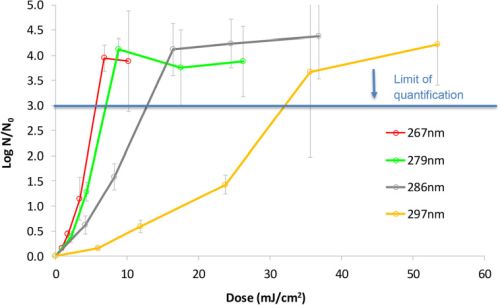
results TAU
TAU results: Dose (fluence) response curve of the HCoV-OC43 to UV-LEDs. N is virus count after the designated irradiation and N0 at time zero (without irradiation).
Researchers say the UV LEDs at 267 and 279 nm were highly effective at inactivating the Coronavirus (3-log inactivation at irradiation 6–7 mJ/cm2), whereas longer UV-LED wavelengths (i.e., 286 and 297 nm) required higher doses for 3-log inactivation (13 mJ/cm2 and 32 mJ/cm2, respectively). But even these wavelengths resulted in effective inactivation.

Generally, the wavelength ~ 260 nm showed slightly higher effectivity then ~280 nm. Increasing the wavelength to ~300 nm caused a dramatic drop in disinfection effectivity. In the same manner, the HCoV-OC43 showed a similar dose-response to irradiation at 267 and 279 nm, somewhat lower sensitivity to 286 nm, and a sharp increase in the required dose when irradiated at 297 nm.

In the future, the researchers say they will test their unique combination of integrated damage mechanisms and more ideas they recently developed on combined efficient direct and indirect damage to bacteria and viruses on different surfaces, air, and water.


You may also like:

  • UV-C LEDs
    Study shows slightly safer UV-C wavelength kills Covid-19 bug
  • Violeds Viosys and SETi
    UV-C LED modules designed for sterilization
  • face-shield-chamber
    Shedding light on how much UV-C you need for disinfection
  • UVC in cars
    Latest connected car feature: Germicidal lights

  • It may become easier to disinfect with UV-C LEDs

Filed Under: Covid-19, FAQ, Featured, LED Lighting Tagged With: covid, FAQ

Reader Interactions

Comments

  1. Mike says

    December 20, 2020 at 5:14 am

    Any clue about the distance of the bulbs from the surface to sanitize? How many bulbs per squared centimeter?
    Thank you for an answer.

Leave a Reply

You must be logged in to post a comment.

This site uses Akismet to reduce spam. Learn how your comment data is processed.

Primary Sidebar

Featured Contributions

Protecting Ethernet interfaces in telecommunications applications against common high energy surges

Ionic cooling: a silent revolution in thermal management

Robust design for Variable Frequency Drives and starters

Meeting demand for hidden wearables via Schottky rectifiers

The case for vehicle 48 V power systems

More Featured Contributions

EE LEARNING CENTER

EE Learning Center

EE TECH TOOLBOX

“ee
Tech Toolbox: Electronic Design Automation
This Tech ToolBox helps to clear the path to faster time-to-market by digging into AI-enhanced design, hardware-assisted verification, parasitic extractions, PCB-to-harness integration, and more.

EE ENGINEERING TRAINING DAYS

engineering
“power
EXPAND YOUR KNOWLEDGE AND STAY CONNECTED
Get the latest info on technologies, tools and strategies for EE professionals.
“bills

RSS Current EDABoard.com discussions

RSS Current Electro-Tech-Online.com Discussions

  • Op amp gain
  • Noisy on amp output
  • cpap change over circuit
  • logic behind conversion method of single ended to differential filter
  • Circuit sensitivity

Footer

EE World Online Network

  • 5G Technology World
  • EE World Online
  • Engineers Garage
  • Analog IC Tips
  • Battery Power Tips
  • Connector Tips
  • EDA Board Forums
  • Electro Tech Online Forums
  • EV Engineering
  • Microcontroller Tips
  • Sensor Tips
  • Test and Measurement Tips

Power Electronic Tips

  • Subscribe to our newsletter
  • Advertise with us
  • Contact us
  • About us

Copyright © 2026 · WTWH Media LLC and its licensors. All rights reserved.
The material on this site may not be reproduced, distributed, transmitted, cached or otherwise used, except with the prior written permission of WTWH Media.

Privacy Policy