
Laser diodes come in a wide range of types and power. They are in DVD and CD players and writers, used in fibre-optic communications, visible laser pointers, distance measurement, printers, medicine and industry. The main decision points are:
- wavelength
- power
- pulsed or continuous.
Wavelength depends on the application. If you want the laser as a pointer then you would obviously choose something in the visible spectrum, probably red if you want the cheapest solution. For medical applications you may have a specific absorption of interest or a fluorescence which will dictate the wavelength e.g. around 490nm for fluorescein angiography. In some cases you could use an LED depending on whether the small source size of a laser or coherence are particular requirements for the application.
The size of a semiconductor laser source can be only 2µm – far smaller than LEDs. However, they are divergent light sources so need optics to make a parallel beam. They are also astigmatic with the apparent source in one plane being in a slightly different place to the source in the other plane. The divergence in the two planes is also different. To get the smallest spot size imaged from a laser diode you therefore need an astigmatic lens which doesn’t rotate when focussed. Most laser pointers use simple lenses so the spot tends to look like a circle or ellipse instead of a clear image of the laser source.
For high power pulsed lasers for rangefinders you would often use 905nm which is invisible to the naked eye. 1540nm is a useful wavelength for improved eye safety as that wavelength is absorbed in the eye before it reaches the retina so higher laser power is allowed while still being eye-safe. While 1540nm was traditionally generated using an Erbium-glass laser, semiconductor lasers are now available at that wavelength. Lasers at 1540nm do tend to cost more than 905nm though, as do the detectors. Absorption in fibre-optic cables is lower though, which can be useful.
The power required depends on what you want to do with the laser but bear in mind eye safety requirements which can severely restrict what you can do if the laser isn’t used in an enclosed environment where it cannot be seen. DVD/CD writers are only eye-safe because you cannot access the laser – the powers used would otherwise not be eye-safe. Powers can range from less than a milli-Watt for measuring instruments to hundreds or thousands of Watts for cutting, marking or medical applications.
Pulsed lasers can be used for laser rangefinders where the high pulsed power combined with the very short pulse gives a low average power and can result in an eye-safe solution. Other pulsed applications are fibre optic data transmission or DVD/CD writing. Continuous driving would be for DVD/CD readers, laser pointers, surveying instruments or some medical applications such as anti-inflammatory use (with 660nm for example).
Driving of lasers depends on the type of laser and whether you are driving them continuously or pulsing them. Some lasers are driven simply by a constant current. This would often be found in DVD readers. If a laser has a built in monitor diode it usually means that you should use it to control the power. That does mean that you need a power meter in order to set the power – the built in monitor diodes are not calibrated. Even with a constant current drive it may be necessary to set the current to achieve a certain power.

Be aware that there a lot of bad laser drive circuits around on the internet and a lot of poor circuits inside the laser pointers you can buy. Many don’t use the built in monitor diode and will have a short laser lifetime. A good control circuit will maintain the laser power even as the temperature changes (such as when the laser warms up). Another requirement is not to overdrive the laser, even for a very short time. Switch on transients can destroy low power lasers very quickly. A good power control circuit need not be complicated. The circuit shown below, with the addition of a large capacitor across R2, will give reasonable power control for a low cost (taken from patent US5199039 – now lapsed).

If you want something more sophisticated there are specialized chips from companies such as iC-Haus GmbH. They make a range of drive chips for various types of laser, some modulated, some continuous, some with fail-safe circuits incorporated. The iC-WK, for example, can be configured to work with most laser diode/photodiode connections, drives up to 70mA or 90mA with reduced temperature range and costs less than $3.

With an average power control circuit you can often modulate a laser using a simple resistor to increase and decrease the current passing through the laser. With some lasers the threshold current can be high – tens of milli-Amps – but the slope efficiency can also be high with only a small extra current being needed to increase the laser power or a small reduction to almost turn if off. This means a handy modulation method can be a simple logic gate connected to the laser through a resistor. Remember to make sure you don’t exceed the peak and average laser power/current. This drive method relies on having a laser power control circuit that controls average power i.e. it has a slow response.
For driving high power pulsed lasers you often require a current of more than 10A and will most likely be looking for pulses less than 100ns. One difficulty in producing very short pulses is the track and package inductance. One method that is still used which helps to overcome that is the use of a high drive voltage and an avalanche transistor such as the ZTX415 from Diodes Inc (previously Zetex).

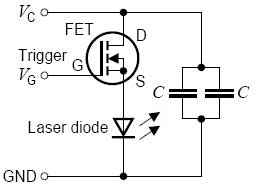
More commonly high power pulsed lasers are simply driven with a MOSFET and lower voltage. A source follower circuit is often used which helps with the speed but limits the working voltage due to the limited gate-source voltage of MOSFETs.
Osram have incorporated a MOSFET within the same package as the laser with devices such as the SPL LL90_3 to overcome the package inductance problem. They also incorporate some capacitance as well so the inductance of the connections from the laser to the capacitance is very low. The MOSFET is connected as a source follower so you are limited to a 20V supply and gate drive. Peak power output is typically 70W at 905nm with a typical 40nm pulse width (FWHM). With the 25W version SPL LL90 you can reduce the pulse width down to 4ns by using a short gate drive pulse, but with reduced peak output power.

Leave a Reply