
• Skip to primary navigation
  • Skip to main content
  • Skip to primary sidebar
  • Skip to footer
  • Subscribe
  • Advertise

Power Electronic Tips

Power Electronic News, Editorial, Video and Resources

  • Products
    • Power Supplies
    • AC-DC
    • DC-DC
    • Battery Management
    • Capacitors
    • Magnetics
    • MOSFETS
    • Power Management
    • RF Power
    • Resistors
    • Transformers
    • Transistors
  • Applications
    • 5G
    • AI
    • Automotive
    • EV Engineering
    • LED Lighting
    • Industrial
    • IoT
    • Wireless
  • Learn
    • eBooks / Tech Tips
    • EE Training Days
    • FAQ
    • Learning Center
    • Tech Toolboxes
    • Webinars & Digital Events
  • Resources
    • Design Guide Library
    • Digital Issues
    • Engineering Diversity & Inclusion
    • LEAP Awards
    • Podcasts
    • White Papers
  • Video
    • EE Videos & Interviews
    • Teardown Videos
  • EE Forums
    • EDABoard.com
    • Electro-Tech-Online.com
  • Engineeering Training Days
  • Newsetter Subscription

Why lithium-ion batteries catch fire: Researchers mimic faults to figure out failure mechanisms

June 15, 2017 By Lee Teschler 1 Comment

Researchers from NASA, the DoE’s Renewable Lab, and the EU are getting insights into why lithium-ion cells fail thanks to the use of a device that induces short circuits inside the battery itself.

The device researchers came up with can induce an internal short circuit on-demand and at a pre-determined location inside commercially available spiral-wound Li-ion batteries. The temperature-activated device mimics hidden defects that can arise during the battery manufacturing processes.

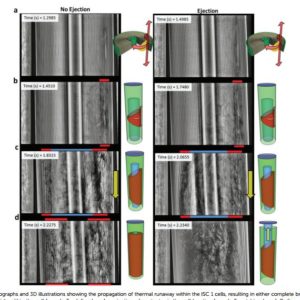
The team used the device, dubbed an internal short circuit (ISC) device, to gain insight into cell design vulnerabilities by causing cell walls to rupture or cells to burst open. To watch what happened, they imaged the events via high-speed X-ray imaging at the European Synchrotron Radiation Facility. There they could observe what unfolded in the cells in real-time, as the short circuit caused the catastrophic failure process to propagate.
battery failure
Radiographs and 3D illustrations from the battery failure work described in the Energy & Environmental Science paper. Visible here is the propagation of thermal runaway within the ISC 1 cells, resulting in either complete breakdown of active materials within the cell (sample 3 – left column) or ejection of contents via the cell bursting (sample 5 – right column). Propagation was quickest in the longitudinal and azimuthal directions from the ISC device, and the azimuthal propagation resulted in a ring-shaped reaction zone (red) around an intact core (semi-transparent blue). As propagation continued in all directions, the intact core (blue) began to move independently, and the reaction either ran to completion within the cell, or the intact core shifted up towards the vent followed by ejection of the electrode assembly.

Individual cells, as well as small cell modules, were tested under conditions that represented a worst-case battery failure scenario. Short circuits were initiated inside the batteries at ~60⁰C. During the failure process, cell temperatures reached in excess of 1,085⁰C. This must have been something to see: Researchers report that batteries exploded on an hourly basis.

The EU synchrotron facility was able to provide high flux X-rays to follow the quick unfolding of events with both high spatial and temporal resolution. Researchers imaged the batteries at up to 2,000 frames/sec. The cells under investigation measured 18 mm in diameter and 65 mm high, but the imaging field of view was in the tens of millimeters deep, enabling the imaging of more than one cell at a time. This helped investigate how failure could propagate from one cell to another, leading to large-scale failure in a battery pack.

Among other things, researchers found that thermal runaway propagates faster in the longitudinal and azimuthal directions, rather than the radial direction, by more than an order of magnitude. Cylindrically shaped fluidized reaction zones developed that essentially resulted in an intact core being encompassed by a fluidized region, reducing the shear stress on the intact electrode assembly and contributing to it shifting towards and clogging the vent. This increased the risk of pressure build-up and cell bursting. So an alternative path for pressure release would help avoid the build-up of pressure when the vent is clogged, researchers say.

Researchers also say sidewall rupture presents one of the greatest hazards during thermal runaway, and was shown to be more likely when thermal runaway initiates closer to the casing of the cell. The cylindrical mandrel in the core of the electrode assembly was also shown to influence the venting process. The mandrel maintains an opening for gasses to escape but may also damage the vent and safety devices at the cap of the cell when propelled during thermal runaway.

Researchers described their work in the journal Energy & Environmental Science.

Filed Under: batteries Tagged With: DOE, NASA

Reader Interactions

Comments

  1. Shane says

    June 21, 2017 at 3:46 pm

    Could the separator be made so that when it got hot, it would release a small amount of acid/alkali/solvent that would quickly dissolve the offending dendrite ?

Leave a Reply

You must be logged in to post a comment.

This site uses Akismet to reduce spam. Learn how your comment data is processed.

Primary Sidebar

Featured Contributions

Vertical power delivery reduces losses in AI processor designs

Protecting Ethernet interfaces in telecommunications applications against common high energy surges

Ionic cooling: a silent revolution in thermal management

Robust design for Variable Frequency Drives and starters

Meeting demand for hidden wearables via Schottky rectifiers

More Featured Contributions

EE LEARNING CENTER

EE Learning Center

EE TECH TOOLBOX

“ee
Tech Toolbox: Aerospace & Defense
This Tech Toolbox dives into the technical realities of modern defense, exploring how MBSE is streamlining aerospace design and what’s next for radar and electronic warfare.

EE ENGINEERING TRAINING DAYS

engineering
“power
EXPAND YOUR KNOWLEDGE AND STAY CONNECTED
Get the latest info on technologies, tools and strategies for EE professionals.
“bills

RSS Current EDABoard.com discussions

RSS Current Electro-Tech-Online.com Discussions

  • EasyEda program has a major bug
  • PCB manufacturing issues
  • Convenient audio FFT module?
  • Mystery amp noise - ??
  • SDCC Array Access In Timer 0 Interrupt Handler

Footer

EE World Online Network

  • 5G Technology World
  • EE World Online
  • Engineers Garage
  • Analog IC Tips
  • Battery Power Tips
  • Connector Tips
  • EDA Board Forums
  • Electro Tech Online Forums
  • EV Engineering
  • Microcontroller Tips
  • Sensor Tips
  • Test and Measurement Tips

Power Electronic Tips

  • Subscribe to our newsletter
  • Advertise with us
  • Contact us
  • About us

Copyright © 2026 · WTWH Media LLC and its licensors. All rights reserved.
The material on this site may not be reproduced, distributed, transmitted, cached or otherwise used, except with the prior written permission of WTWH Media.

Privacy Policy