
High-voltage supercapacitor balancing printed circuit boards are designed to automatically control leakage current and enhance reliability for applications used in data center, industrial automation, public utility, and transportation systems.
ALD SABMB810028 boards built with ALD810028SCLI SAB (supercapacitor auto-balancing)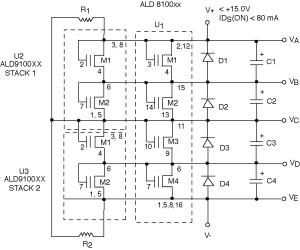 MOSFETs provide balancing for 2.8-V, 3.0-V and 3.3-V supercapacitors arranged in a series stack by equalizing the leakage current of each cell. ALD SAB MOSFET arrays used in each board provide industry’s most scalable, low-power solution. Additionally, the MOSFETS balance each cell through low levels of leakage current without exposure to supercapacitor charge/discharge voltage levels for cells of 3,000 Farad or more.
ALD SABMB810028boards are rated for -40 to +85°C and are available with the following voltage ratings:
• 2.8 V with 1 µA operating current;
• 3 V with 100 µA operating current;
• 3.3 V with 1,000 µA operating current.
In many cases, the operating current is equivalent in magnitude to the leakage current of the supercapacitors.
Overvoltage is a leading cause of failures for supercapacitors. Design engineers need to balance all supercapacitor cells in a stack of two or more to fight overvoltage. ALD’s SAB MOSFET(s) installed on the board play a vital role in preventing overvoltage, and the boards enable system engineers to test, evaluate, prototype or enter production volume. ALD SAB MOSFET technology provides a superior circuit design to other passive or active balancing scheme through superior cost and design space options for supercapacitor leakage currents.
The boards are scalable to meet the growing application of multiple supercapacitor cells in modules to meet the energy storage needs of higher voltage systems. Engineers looking to meet the needs of new 700-V systems, for example, could arrange 64 ALD SABMB810028 boards together to ensure safe voltage balancing.
The ALD SAB MOSFET boards allow supercapacitor cell charging and discharging currents to pass through the cells themselves directly, bypassing SAB MOSFETs mounted on the board with near zero additional leakage current, a superior alternative to other methods where additional power dissipation used by the circuitry far exceeds the supercapacitor energy burn caused by leakage currents.
SABMB810028 board is designed for ease of use as a plug-and-play PCB for supercapacitors of 0.1 F to 3,000 F and beyond. The average additional power dissipation due to dc leakage of the supercapacitor is zero, which makes this method of supercapacitor balancing highly energy efficient and well suited for low-loss energy harvesting and long-life battery operated applications.
Products can be ordered directly from Advanced Linear Devices or ordered from online distributors DigiKey or Mouser. Prices start at $30.17 each for boards ordered in volume.

Leave a Reply