
There is an art to getting accurate readings of high current values. It pays to know a few of the tricks.
GEORGES EL BACHA, EVAN SHORMAN, HARRY CHANDRA | ALLEGRO MICROSYSTEMS LLC
IT CAN BE CHALLENGING to sense currents exceeding 50 A because the task often involves thermal management, must take place in a limited PCB area, and in some cases, requires a voltage isolation device. Two widely used methods for sensing high currents are a sense-resistor/op-amp approach, and Hall-based current sensing. It is useful to compare these two techniques. Recently developed Allegro MicroSystems integrated current sensors, ACS780LR and ACS770CB, will be used as examples.

Traditionally, the typical way to measure current is by putting a sense resistor in series with the current-carrying conductor. An op amp may then measure the voltage drop across the resistor, and the current is calculated from Ohm’s law. The nominal resistance of the sense resistor is selected to supply a sufficiently large voltage while also minimizing the power dissipation (P = I2R).
Large currents will require a low resistor value (usually 1 to 50 mΩ) to minimize the heat generated on the board. However, too-low resistor values will lead to a small sensed voltage and, in turn, a low-accuracy measurement. Low resistor values will also have a large footprint that consumes valuable PCB area. The thermal coefficient of the sense resistor and the voltage offset of the op-amp will also contribute to the measurement error. As a result, designers must balance among accuracy, power consumption, thermal management, PCB area, and cost.
It’s often best to measure current near the supply voltage of the load (the high-side) instead of near ground (the low-side). Measuring on the high-side brings immunity to ground bounces and allows for the detection of short circuits to ground. Depending on the supply voltage and the application, basic or reinforced isolation might be needed for sense-circuit connections. If a sense-resistor/op-amp are used to measure on the high-side, an op-amp with a high common-mode input range will be necessary, making the design more complex. To provide isolation, additional isolators (such as optocouplers) and isolated power supplies will be needed, increasing complexity and boosting costs.
On the other hand, Hall-effect current sensor ICs, such as those provided by Allegro, eliminate the need for a sense-resistor. The current flows directly into the integrated conductor, generating a magnetic field that will be measured.
The ACS780 sits in a 6.4 × 6.4-mm surface mount LR package. Current flows into the integrated conductor and generates a magnetic field that on-die Hall elements then sense. Use of a flip-chip assembly technique brings the Hall elements quite close to the leadframe where the magnetic field is at its highest point. This packaging allows for superior signal-to-noise ratio.
The device uses two Hall elements to detect and reject any external stray magnetic field. The integrated conductor has a low 200-µΩ resistance to reduce power dissipation, allowing for more than 100 A of continuous current measurement with a 120-kHz bandwidth. Thermal performance depends highly on PCB design and layout
The ACS770 sits in a 14 × 21.9-mm through-hole CB package. As current flows in its integrated conductor, an integrated low-hysteresis core concentrates the magnetic field which is then sensed by the Hall element with a typical accuracy of ±1% and 120 kHz bandwidth. The core also acts as a magnetic shield, rejecting external stray fields.
The integrated conductor has 100-μΩ resistance, providing ultralow power loss. The ACS770 can measure 200 A continuously at an ambient of 85°C and can be factory programmed to measure inrush currents up to 400 A.
Thermal performance
To determine the appropriate sensor for an application, it’s important to understand the thermal performance under high-level transient currents and constant dc/RMS currents. For the examples that follow, all measurements took place at 25°C ambient and could be used to derate the sensors at different operating temperatures.

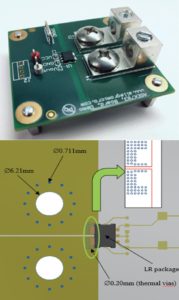
High-current pulse testing of the LR package took place using the Allegro ACS780 evaluation board. This is an eight-layer board with two-ounce (70 μm) copper and an FR4 substrate. Thirty-six thermal vias of 0.2-mm diameter were placed next to each of the solder pads of the integrated current conductor.
The package then experienced a current pulse of a set magnitude and the time was measured for two conditions: the time for the die temperature to exceed the maximum junction temperature of 165°C, and the time to fuse the current conductor open.
All testing of the CB package took place using the Allegro ACS770 evaluation board. This is a two-layer board with four-ounce (140 μm) copper and an FR4 substrate. Sixteen thermal vias of 0.5-mm diameter were placed next to each of the solder pads of the integrated current conductor.
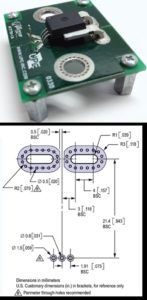
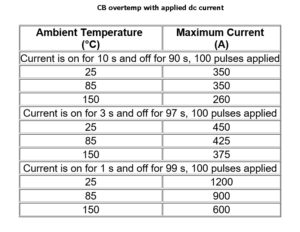
When subjected to high-current pulse testing, the CB package did not fuse at 1.2 kA—the maximum current capability of the lab equipment performing this measurement. The nearby table shows the maximum current pulse duration and duty cycle that could be applied to remain within the safe operating zone where the die temperature of 165°C is not exceeded.
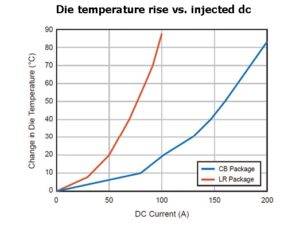
A nearby figure shows die temperature rises as continuous dc current is injected through the sensors and temperature reaches steady state. As expected, the CB package shows a smaller temperature increase because of its lower conductor resistance of 100 μΩ compared to 200 μΩ for the LR package.
The system thermal performance depends greatly on the PCB layout and can be improved in several ways: by incorporating multiple layers of metal to better dissipate the heat under the IC, by adding a heat sink as close as possible to the IC, or by adding thermal vias (that connect all metal layers) surrounding the Allegro IC integrated conductor solder pads.
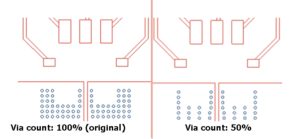
Of the three methods, adding thermal vias has the least impact on PCB area and cost, and it is easy to implement. To understand the impact of vias and how many to use, a simulation was run on the ACS780LR evaluation board using a natural convection model. The model assumed an air enclosure of 300×300×300 mm with the enclosure wall set to 25°C. The injection of current caused the steady-state die temperature to reach 150°C.
Reducing the number of thermal vias by 50% (18 instead of 36 vias per solder pad), brought a 5.6°C rise in die temperature to 156°C. Removing all thermal vias caused a 33.5°C rise in die temperature to 183.5°C. These results highlight the significant benefits of having thermal vias, while showing that a small reduction in the number of vias (much less than a 50% reduction relative to the Allegro evaluation board) should have a minimal impact on the thermal performance.
The small footprint of the ACS780 in the LR package and its ease of surface-mount assembly brings advantages for measuring currents exceeding 100 A. The approach is to reroute a portion of the current to be sensed through a trace on the PCB. Thus, a portion of the current to be sensed does not pass through the Allegro IC. Here, the current ratio of the splitter is critical. It must be set so the maximum possible current flows through the sensor (while the sensor remains in the thermal safe operating zone) to get the best accuracy.
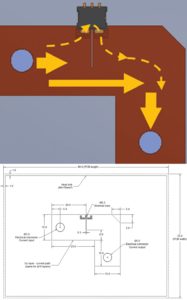
A simulation illustrates the thermal capability of this approach. Suppose we have a board with a current ratio of 6.7:1 (that is, current through trace: current through sensor) and the following specifications: six copper layers (top and bottom layer thickness of two-ounce (70 μm), inner layers of three-ounce (105 μm)), an FR4 substrate, 36 thermal vias of 0.2-mm diameter around each pad, and 5-mm diameter through-holes for current injection on the PCB. An aluminum heat spreader of 94 × 70 mm connects under the PCB.
With 250 A injected in the PCB, a simulation assumed natural convection with an air enclosure volume of 300×300×300 mm with the enclosure wall set to 25°C. The highest observed temperature was 74°C on the top metal (~50°C rise relative to the ambient temperature), while the die temperature reached 71°C.
Allegro current sensors are galvanically isolated, offering an efficient way to measure on the high-side. The ACS780LR targets applications where the supply voltage is less than 100 V. Its construction provides inherent isolation, because the active circuitry on the die is not electrically connected to the current conductor.
The ACS770 is certified to UL 60950-1 2nd edition, passing 4.8 kV for 60 sec. Its basic Isolation working voltage is 990 (Vpk or dc) or 700 Vrms, while its reinforced isolation working voltage is 636 (Vpk or dc) or 450 Vrms.
All in all, advances in packaging and circuit design have simplified the task of using Hall current sensor ICs to measure currents exceeding 50 A on a PCB. Accurate and galvanically isolated sensing can take place economically with little power loss by using the small surface-mount ACS780 or through-hole ACS770.
References


[…] Secrets of measuring currents above 50 amps Traditionally, the typical way to measure current is by putting a sense resistor in series with the current-carrying conductor. An op amp may then measure the voltage drop across the resistor, and the current is calculated from Ohm’s law. The nominal resistance of the sense resistor is selected to supply a sufficiently large voltage while also minimizing the power dissipation (P = I2R). How we devised a wirelessly powered television set There are two widely used forms of magnetic field-based wireless power transfer techniques: inductive and highly resonant. Each has advantages and disadvantages. […]