
by Jerry Hovdestad, Director COTS Engineering, Behlman Electronics
To an engineer, power management is also thermal management. Excess heat generated by power systems places additional burdens on their cooling technology. Even the most efficient system will have performance and reliability issues if served by an inefficient cooling method. Power and heat are two sides of the same coin, and both must be addressed in order to achieve higher power densities.
High temperatures can damage electronic systems or, at best, the protective circuitry will shut them down. Therefore, it is essential that engineers pay careful attention to the actual thermal performance of the system and be aware of every aspect of the thermal cooling path. Chassis design and tolerances, as well as all conductive elements, are critical to system performance.
Heat vs Power Density
Creating more efficient electronics to lower waste heat, and heat-extraction systems to manage it, are at the core of increased power density. In the case of rugged high-performance power systems, the physical constraints of the form factor and packaging required place an even greater burden on thermal management. As a result, power systems have serious power-density issues that severely challenge system designers.
Specified by many major defense contractors, Behlman’s VPXtra power supplies are used in their latest advanced VPX-based systems, due to Behlman’s ability to deliver superior power, efficiency and thermal management. Behlman’s careful attention to detail in electrical and mechanical design, along with judicious use of materials to address the issues of heat transfer versus weight, are key. For example, copper can transfer roughly twice the heat of aluminum, but weighs almost twice as much. Behlman uses the most advanced techniques available to maximize thermal performance, including state-of-the art heat pipes that help optimize control.
Addressing the issues of circuit efficiency and thermal management, Behlman’s Xtra-Cooling technology breakthrough uses a unique card-edge conduction-cooling methodology. This enables 6U power systems, such as Behlman’s dual-output VPXtra1000CD, to deliver an unprecedented 1,000 W of clean, regulated 12 Vdc power and 3.3 Vdc auxiliary power, with a typical efficiency of 90% from a wide-range 28-Vdc input.
Behlman’s VPXtra1000CD is a rugged, highly reliable switch mode unit, well-suited for high-end industrial applications, as well as for mission-critical military airborne, shipboard, vehicle and mobile systems. The 1000CD is OpenVPX Vita 62 compliant, and standard features include overvoltage, short circuit and thermal protection, with no minimum load requirement.
The VPXtra1000CM COTS dc-to-dc power supply is a rugged, highly reliable, conduction-cooled, switch mode unit. It is a VITA 62, Open VPX compliant, 6U power supply that delivers 700 W of dc power through five outputs, and its 12-V output can be paralleled for higher power and redundancy.
The Behlman VPXtra1500CS gave VPX design engineers the ability to obtain a dc output from a three-phase ac source to support design initiatives requiring power factor correction and input current harmonic reduction. Although initially conceived to power Behlman’s VPXtra1000CD and VPXtra1000CM dc-to-dc power supplies, VPXtra1500CS can also be used to power devices from other manufacturers having similar wide-range dc inputs.
Behlman VPXtra 6U power supplies are also designed to meet the applicable sections of MIL-STD-461 for conducted emissions, conducted susceptibility and radiated susceptibility. In accordance with MIL-HDBK-217F Notice 2, MTBFs are 336,000 hours for VPXtra1000CD; 277,000 hours for VPXtra1000CM; and 209,000 hours for VPXtra1500CS (see Figure 1).

Fitting smaller form factors
Behlman’s latest VPXtra power solution addresses the growing need for a smaller form factor. The Behlman VPXtra500M is a 3U COTS dc-to-dc power supply. It is a rugged, highly reliable, conduction-cooled, switch mode unit that is VITA 62 and Open VPX compliant, delivering up to 560 W of dc power through six outputs (see Figure 2). The 12, 3.3 and 5 V main outputs can also be paralleled for higher power.
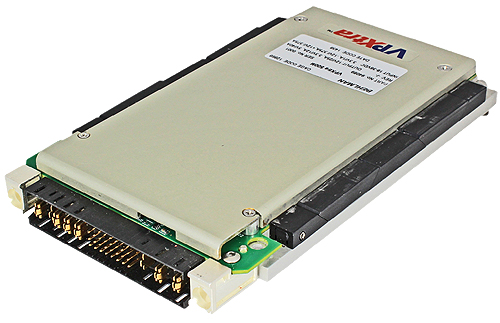
The VPXtra500M accepts 18 to 36 Vdc input, is compliant with MIL-STD-704, and can supply high-power dc output, requiring no minimum load and providing overvoltage, short circuit, overcurrent and thermal protection. Behlman’s Xtra-Cooling technology, with its unique card-edge conduction-cooling, enables these power supplies to operate at full power up to a maximum rail temperature of 85° C.
All VPXtra power supplies incorporate Behlman’s Xtra-Reliable design and Xtra-Rugged construction. They are designed and manufactured to meet VITA 47 for shock, vibration, and humidity, and MIL-STD-461 for EMI.
Cost of Ownership
The U.S. Navy has long led the way in quantifying what’s important to a reliable power supply design, driving the use of COTS, in order to take advantage of established reliability and cost savings. This experience led the Navy to revise its guidelines and publish NAVSO P-3641A, which replaces NAVMAT P-4855-1A. This paper outlines the total cost of ownership and highlights the benefits of modified COTS power supplies, such as those built by Behlman.
The Navy recognized that the design approach to using modules is not simple, and a number of other components will be required to meet key criteria, such as EMI filtering, input ac-to-dc rectification, hold-up capacitance, output filtering, auxiliary circuitry (sequencing, BIT, On/Off), cooling and packaging. Behlman’s years of designing advanced hi-rel power systems, including extensive module selection experience, EMI input and output filtering, hold-up, transient protection, efficient cooling practices for both conduction and convection, parallel and N+1 Designs and control, and BIT circuits, has led to the creation of more than 75 COTS power products that are ruggedly built and designed to meet the rigors of high-end industrial and military applications on aircraft, shipboard, ground or mobile platforms.
About Behlman Electronics
Behlman Electronics is a subsidiary of Orbit International and a key member of the Orbit Power Group. Behlman designs and manufactures a wide array of power products including ac power supplies, frequency converters, inverters, uninterruptible power supplies (UPS), COTS (dc-dc, ac-dc and dc-ac), power sources and VPX/VME power supplies, as well as modified standard power supplies and railroad signal sources for commercial, industrial and mission-critical applications. All product information and data sheets are immediately available at www.behlman.com.

Leave a Reply