
Four new SiC FETs, with RDS(on) levels as low as 7 mΩ deliver unprecedented levels of performance and efficiency for use in high-power applications such as electric vehicle (EV) inverters, high-powered dc/dc converters, high-current battery chargers and solid-state circuit breakers. Of the four new UF3C SiC FET devices, one is rated at 650 V with RDS(on) of 7 mΩ, and three rated at 1,200 V with RDS(on) of 9 and 16 mΩ series devices. All are available in the versatile TO247 package.
These new SiC FETs combine a high-performance third-generation SiC JFET and a cascode-optimized Si MOSFET. This circuit configuration creates a fast, 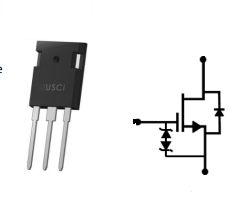 efficient device in a familiar package that can be driven with the same gate voltages as Si IGBTs, Si MOSFETS and SiC MOSFETs. In addition, to optimize high-temperature operation, silver sintering provides low thermal-resistance mounting for the TO247 package.
The UF3SC065007K4S has a maximum operating voltage of 650 V, a drain current of up to 120 A, and an RDS(ON) of 6.7 mΩ. The UF3SC120009K4S has a maximum operating voltage of 1,200 V, drain current of up to 120 A, and an RDS(ON) of 8.6 mΩ. Both come in a four-lead Kelvin package, enabling cleaner drive characteristics.
For lower-power designs, UnitedSiC offers two parts with maximum operating voltages of 1,200 V, drain currents of up to 77 A, and an RDS(ON) of 16 mΩ. The UF3SC120016K3S has a three-lead package, while the UF3SC120016K4S has a four-lead package.
The low RDS(ON) characteristic of these devices make it possible to achieve efficiencies of more than 99% in inverter designs. The excellent reverse recovery performance helps in this regard, along with the low conduction drop of in the freewheeling mode.
Inverter designers will be able to extract more power from their existing designs without reinventing their basic circuit architecture, by switching at the same speed but handling higher currents without excessive resistive heating.
The parts also work well in parallel to handle high currents. Careful loss calculations show that the combined switching and conduction losses of a 200 kW, 8-kHz inverter built using six UF3SC120009K4S SiC FETs in parallel will be about one third those of a similar inverter built using state of the art IGBT/diode modules.
The ultra-low conduction losses enabled by the low RDS(ON) figures of the UF3C series SiC FETs mean the devices can also be used as solid-state circuit breakers and battery disconnect switches in EVs. The devices can turn off high currents quickly, and when used as a circuit breaker, have a self-limiting characteristic that controls the peak current that flows. This characteristic can also be used to limit inrush currents flowing into inverters and motors.
The UF3Cseries SiC FETs can form the basis for more efficient high-current battery chargers. For lower battery-voltage systems, the UF3SC65007K4S offers much greater efficiencies in charging circuits than IGBT-based systems. If SiC FETs are used to build a synchronous rectifier to replace the secondary-side diodes, this also dramatically cuts losses and so reduces the cooling burden on the charger. For example, at a 100 A operating current with a 50% duty cycle, a JBS diode will have conduction losses of nearly 100 W, but the UF3SC065007K4S working as a synchronous rectifier will have conduction losses of just 45 W.
Pricing for 1,000+ units ranges from $35.77 for the UF3SC0120016K3S to $59.98 for the UF3SC120009K4S. Samples are available now, with production volumes in Q2’2020.
UnitedSiC, 7 Deer Park Drive, Suite E, Monmouth Junction, NJ 08852, (732) 355-0550, www.unitedsic.com.



Leave a Reply