
Long-life pacemakers powered by plutonium-based thermal decay were implanted beginning in the 1970s, but better battery technology, safety concerns, and regulatory issues made them obsolete within a few decades.
Recently, I was surfing through my free over-the-air (OTA) TV channels and stumbled across a show from the 1970s called “To Tell the Truth” (there is also a current “reboot” version). The premise of the show is simple: there’s a person with a unique or interesting talent, life story, or skill, as well as two imposters. What’s special about this person is not kept secret, as the host reads a brief affidavit explaining it to the four panelists as well as the TV audience.
The panelists then try to determine who is the real person rather than either of the two imposters by asking a few questions. The challenge is that the panelists usually know little or nothing about the unique attribute, and so must improvise their questions and assess the credibility of the answers. It’s actually not easy (note that this show’s set-up is in contrast to one of its competitors at the time called “I’ve Got a Secret,” where the panelists must ask questions and guess the “secret” of the guest contestant).
So, I was surprised when they introduced a young lady, about 25 years old, whose story was that she had a nuclear-powered cardiac pacemaker. That’s certainly not something you’d expect. She’d had it for a few years, and it was still operating quite well.
I immediately did some web searching to get the details of this intriguing story. Obviously, it wasn’t nuclear fusion (still working on that as a power source), and I doubted if it was a tiny fission reactor (the smallest ones in continuous use were in nuclear submarines). Instead, it was a thermal generator powered by the heat of the natural decay of plutonium, formally known as a radioisotope thermoelectric generator (RTG).
This FAQ will look at the strange and fascinating lifecycle of this device, which went far beyond “experimental.”
The Challenges
Q: What does a cardiac pacemaker do?
A: In simplest terms, it provides electrical impulses to the heart as needed to maintain proper heartbeat and rhythm (Figure 1). This is an oversimplification, of course, as there are actually three main classes of pacemakers targeting different cardiac issues and problems.

Q: When was the pacemaker developed and used?
A: The first fully internal pacemaker was implanted in 1958 in Sweden. Prior to that, there were external, wearable pacemakers, table-top pacemakers, and even mechanical stimulus units (a full, fascinating history from NIH with many photos is called out in Reference 1). Note that the issues associated with a practical pacemaker are not just related to the circuitry and its components; even the leads going to the heart require technical innovation for safety, longevity, flexibility, inertness, and performance.
Q: Why even consider a non-electrochemical (conventional) battery for the implanted pacemaker?
A: It’s an answer that still resonates: the limited energy and thus runtime – actually, “lifetime” would be more realistic since it affects the lifetime — of the battery technology of the time; in this case, mercury-zinc batteries would be used. These batteries could power the pacemaker for 1-2 years — obviously, an unattractive situation.
Q: Why not use our well-known lithium-ion batteries?
A: Easy: they weren’t yet available (see the recent IEEE Spectrum article (Reference 2) for an insightful review of their history). Mercury-zinc was the best available.
Q: What about rechargeable batteries and wireless recharging?
A: In theory, that’s a great idea. But there are many practical issues with such batteries, including energy density, the number of actual recharging cycles available (about 500 to 1000) before they need to be replaced, and challenges with the wires charging aspects through skin and tissue. Even today, with our greatly improved rechargeable batteries and wireless recharging technology, they are generally not used.
Q: How do the “nuclear-powered” pacemakers act as battery replacements?
A: A series-connected array of thermocouples is called a thermopile (Figure 2) and it creates useful energy at a low voltage using the heat given off by an adjacent source such as mundane as a flame or as exotic as the natural decay of the plutonium-238 (Pu-238) isotope.

The pacemaker uses the same technology, but on a far smaller scale, as is used in the radioisotope thermoelectric generators which are in nearly every manned and unmanned spacecraft, when solar cells are partially or totally inadequate and storage batteries for full-time power needs (see related content).
Q: How many such pacemakers were implanted? When did this begin?
A: Experiments on dogs were done in the 1960s, and the first unit was implanted in France in 1970. Since 1970 about 1400 units have been implanted in patients.
Q: Who were some of the suppliers of these pacemakers?
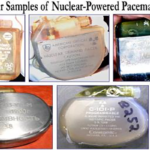
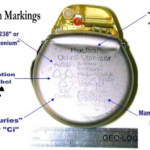
A: There were a surprising number of sources, and they have changed names, merged with other companies, or disappeared. Among them were ARCO (Perma-grain), Medtronic (Laurens-Alcatel), Gulf General Atomic, Cordis (Telektronic, Accuffix), American Optical, Biocontrol Technology (Coratomic), and Medical Devices, Inc (MDI).
The next part looks at the technology of the nuclear-powered pacemakers.
EE World related content
Need a really long-life battery or heat? Try a radioisotope thermal source – problem solved! – Part 1
Need a really long-life battery or heat? Try a radioisotope thermal source – problem solved! – Part 2
Need a really long-life battery or heat? Try a radioisotope thermal source – problem solved! – Part 3
Need a really long-life battery or heat? Try a radioisotope thermal source – problem solved! – Part 4
Need a really long-life battery or heat? Try a radioisotope thermal source – problem solved! – Part 5
Engineering the atomic submarine, Part 1: One man’s audacity, determination, dedication revolutionized naval reality
Engineering the atomic submarine, Part 2: One man’s audacity, determination, dedication revolutionized naval reality
Smoke detectors and alarms, Part 1
Smoke detectors and alarms, Part 2
Smoke detectors and alarms, Part 3
Smoke detectors and alarms, Part 4
References
National Institutes of Health, “A brief history of cardiac pacing”
IEEE Spectrum, “Who Really Invented the Rechargeable Lithium-Ion Battery?”
The Wall Street Journal, “How Do You Handle a Plutonium-Powered Pacemaker?” (behind a paywall)
Los Alamos National Laboratory, “Nuclear-Powered Cardiac Pacemakers”
Oak Ridge Museum of Radiation and Radioactivity, “Plutonium Powered Pacemaker (1974)”
Stanford University, “The History of Nuclear Powered Pacemakers”
Medical Design and Outsourcing, “MedTech Memoirs: The Plutonium-Powered Pacemaker”
Nuclear Newswire, “The case of the Pu-powered pacemaker”
Washington Heart Rhythm Associates, LLC, “Permanent Pacemaker: What is a pacemaker?”


Leave a Reply