
Wireless charging of devices is a hot and growing area. This FAQ explores the rationale and options for implementing this form of energy transfer, storage, and charging.
Q: What is wireless charging?
A: It consists of two functions which are closely linked. The first is the transmission of electricals power wirelessly from a transmitting source to a receiver; the second is the capture, extraction, and storage of this power at the receiver for immediate or future use.
Q: Is wireless power new?
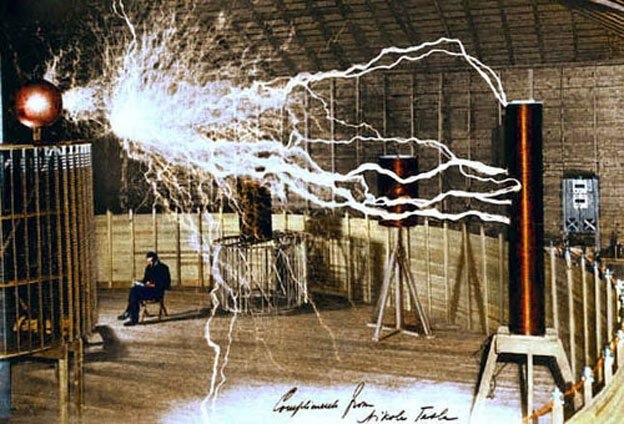
A: No and yes. It is “no” because the famous scientist, engineer, and innovator Nikola Tesla (among others) did some pioneering but ultimately frustrating work on the subject beginning in the 1890s and into the early part of the 20th century (Figure 1). It’s also been the subject of countless speculative-science and science-fiction stories.
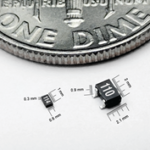
Further, it is widely used for charging of small home alliances such as electric toothbrushes and shavers, personal wearables, and even implanted medical devices such as pacemakers (Figure 2). Of course, a standard radio link is a form of wireless power transmission, where anywhere from less than a watt to many kilowatts is transmitted, and a tiny amount of this power (nanowatts or microwatts) is captured by a receiving antenna. Other than these types of constrained applications, wireless charging has not seen widespread adoption.

But it is a “yes” because there has been a surge of interest in recent years, driven by new applications such as charging of smartphones and laptops (especially in public spaces) and even charging of EVs (electric vehicles). The demand is both driven by, and driving, the technologies and components needed for effective wireless charging.
Q: Why even consider wireless power transmission and charging?
A: In principle, it offers user convenience and benefits. First, there’s no need to carry an assortment of chargers and adapters. Second, it makes recharging easy: just place the device on the charging pad and leave it there. Third, of great interest to public spaces such as airports and hotels, lack of physical connectors implies increased long-term reliability. The reason is that standard USB and similar power connector are simply not made for the thousands of insertion/removal cycles they undergo in such settings, plus an “open” connector is prone to inadvertent damage and even vandalism.
Q: If there are these pluses, what are the downsides?
A: Wireless charging is not a panacea or “no-brainer.” First, it adds some cost, weight, and complexity to the individual power-receiving units, and they are borne by the end user. Management of both the power transmitter and complementary receiver is much more complicated than it is for a hard-wired charging link. The dictates of the laws of physics and the required electromagnetic components (in addition to power-management ICs) adds to the system BOM cost while a basic plug-in charger is inexpensive, and easily available (convenient stores, gas stations, and pharmacies). Also, if an AC outlet is broken or unavailable, users can probably find another one nearby — an unlikely situation with a wireless charger setup. Finally, it’s an issue of critical mass and “which comes first”: unless those wireless chargers are “everywhere,” users will still likely want to bring their wired chargers “just in case.”
Q: Are those the only downsides?
A: There are issues of consistency and efficiency. A wired charger and its cable are fairly reliable, and if there’s a problem it is easily diagnosed and resolved, but a wireless system is more opaque and harder to assess. Aggravating the problem, if there are multiple incompatible wires-charging standards, a set-up at a hotel for one type may work for one person’s unit but may work for another’s, which would be very frustrating.
Also, a wired charging link itself is close to 100% efficient (the efficiency of the power conversion at either end is not, of course) whereas a wireless link is far less efficient, ranging from 30% to about 75% under optimum conditions. This has costs in both meeting regulatory mandates for efficiency, and also the length of charging time, and that last point is a key “satisfied user” factor.
Finally, there are issues of how much power can be conveyed wirelessly. Charging a smartphone — on the order of 5 W — is a modest challenge; charging a laptop or similar requires transmitting power which is an order of magnitude greater, and the growth in technical challenge, required hardware, and node-management issues is not linear as power increases; it is exponential.
There’s also a “hidden” concern with wireless charging, especially as wireless power levels and distances increase: it adds to the “cloud” of EMI/RFI which surrounds us, may affect nearby devices, and may even cause erratic behavior and malfunctions in some for them. The possible health impact of energy fields is unclear but a likely concern as well.
Part 2 of this FAQ will explore the basic approaches to wireless charging and industry standards.
References
Infineon Technologies, “Wireless charging solutions.”
EE World, “Wireless charging: Will the exception soon become the rule


[…] Part 1 of this FAQ looked at the overall context of wireless charging of personal devices. This part looks in more detail at the approaches to wireless charging and the implementation specifics. […]