• Skip to primary navigation
  • Skip to main content
  • Skip to primary sidebar
  • Skip to footer
  • Subscribe
  • Advertise

Power Electronic Tips

Power Electronic News, Editorial, Video and Resources

  • Products
    • Power Supplies
    • AC-DC
    • DC-DC
    • Battery Management
    • Capacitors
    • Magnetics
    • MOSFETS
    • Power Management
    • RF Power
    • Resistors
    • Transformers
    • Transistors
  • Applications
    • 5G
    • AI
    • Automotive
    • EV Engineering
    • LED Lighting
    • Industrial
    • IoT
    • Wireless
  • Learn
    • eBooks / Tech Tips
    • EE Training Days
    • FAQ
    • Learning Center
    • Tech Toolboxes
    • Webinars & Digital Events
  • Resources
    • Design Guide Library
    • Digital Issues
    • Engineering Diversity & Inclusion
    • LEAP Awards
    • Podcasts
    • White Papers
  • Video
    • EE Videos & Interviews
    • Teardown Videos
  • EE Forums
    • EDABoard.com
    • Electro-Tech-Online.com
  • Engineeering Training Days
  • Newsetter Subscription

High-voltage bi-directional current-sense amplifiers boost power efficiency

February 24, 2021 By Redding Traiger Leave a Comment

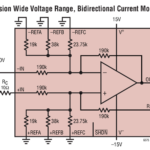
STMicroelectronics has introduced three precision high-voltage bi-directional current-sense amplifiers that provide the extra convenience of a Shutdown pin to maximize energy savings.

The TSC2010, TSC2011, and TSC2012 amplifiers also allow designers to minimize power dissipation by leveraging their precision characteristics to select low sense-resistor values. The offset voltage is within ±200µV at 25°C, with less than 5µV/°C drift, and gain accuracy is within 0.3%, enabling the devices to detect a voltage drop as low as 10mV full-scale to provide consistently and trusted measurements.

The gain variety — 20V/V for the TSC2010, 60V/V for the TSC2011, and 100V/V for the TSC2012 — gives the flexibility to build precision current measurement, overcurrent protection, current monitoring, and current-feedback circuits for many different industrial and automotive systems. Uses include data acquisition, motor control, solenoid control, instrumentation, test and measurement, and process control.

With their bi-directional capability, the three new amplifiers help designers trim their bill of materials by allowing a single sensing circuit to measure the current flowing in forward and reverse directions. The devices are also suitable for high-side and low-side connection, enabling the same part number to be used in both configurations for easier inventory management.

All the new devices have a wide supply voltage range, from 2.7V to 5.5V, adding further to their flexibility. Their wide input-voltage tolerance allows sensing over a range of common-mode voltages from -20V to 70V at any supply voltage. With a high gain-bandwidth product and fast slew rate — 820kHz and 7.5V/µs in the TSC2010 — they ensure high accuracy and fast response.

The devices feature an integrated EMI filter and 2kV HBM (Human Body Model) ESD tolerance, ensuring robust performance, and operate over the industrial temperature range -40°C to 125°C.

Designers can accelerate time to market by taking advantage of the accompanying STEVAL-AETKT1V2 evaluation kit for a fast start to projects using any of the three devices.

The TSC2010, TSC2011, and TSC2012 are available now in Mini-SO8 and SO8 packages, priced from $0.90 for orders of 1000 pieces. Automotive-grade devices are priced from $1.08 for orders of 1000 pieces.

For more information, please go to www.st.com/current-sense-amplifiers
You may also like:

  • acopian
    Picking reliable power supplies

  • Measuring a sense-resistor’s voltage drop, Part 3: CMV-suitable components
  • sense-resistor
    Measuring a sense-resistor’s voltage drop, Part 2: Isolation

  • What are switched capacitor filters, amplifiers and integrators?

  • Measuring a sense-resistor’s voltage drop, Part 1: Sensing issues
  • digital power
    Digital power conversion – how does that work?
  • analog devices
    How bidirectional converters speed the design of dual-battery automotive systems

  • Heat sinks, Part 1: Thermal principles

Filed Under: Amplifier, Automotive, Development Tools, Industrial, Motors and motor control Tagged With: stmicroeletronics

Reader Interactions

Leave a Reply

You must be logged in to post a comment.

This site uses Akismet to reduce spam. Learn how your comment data is processed.

Primary Sidebar

Featured Contributions

Protecting Ethernet interfaces in telecommunications applications against common high energy surges

Ionic cooling: a silent revolution in thermal management

Robust design for Variable Frequency Drives and starters

Meeting demand for hidden wearables via Schottky rectifiers

The case for vehicle 48 V power systems

More Featured Contributions

EE LEARNING CENTER

EE Learning Center

EE TECH TOOLBOX

“ee
Tech Toolbox: Electronic Design Automation
This Tech ToolBox helps to clear the path to faster time-to-market by digging into AI-enhanced design, hardware-assisted verification, parasitic extractions, PCB-to-harness integration, and more.

EE ENGINEERING TRAINING DAYS

engineering
“power
EXPAND YOUR KNOWLEDGE AND STAY CONNECTED
Get the latest info on technologies, tools and strategies for EE professionals.
“bills

RSS Current EDABoard.com discussions

RSS Current Electro-Tech-Online.com Discussions

  • H bridge current direction logic
  • Very Curious Issue With DS3231 RTC Clock
  • Distorted output from buffer
  • Motor Getting Hot
  • excessive technology in multimeters

Footer

EE World Online Network

  • 5G Technology World
  • EE World Online
  • Engineers Garage
  • Analog IC Tips
  • Battery Power Tips
  • Connector Tips
  • EDA Board Forums
  • Electro Tech Online Forums
  • EV Engineering
  • Microcontroller Tips
  • Sensor Tips
  • Test and Measurement Tips

Power Electronic Tips

  • Subscribe to our newsletter
  • Advertise with us
  • Contact us
  • About us

Copyright © 2026 · WTWH Media LLC and its licensors. All rights reserved.
The material on this site may not be reproduced, distributed, transmitted, cached or otherwise used, except with the prior written permission of WTWH Media.

Privacy Policy