
There are quite a few different types of semiconductor diode from junction diodes, Schottky diodes, Zener diodes etc. You need to know the difference between them in order to select one. A good place to start the description of the types would be a comparison of a conventional PN junction diode and a fast recovery diode. What does the “fast recovery” actually mean and why should you care?
The “recovery” is from conducting to not conducting (i.e. blocking). It is probably easiest to illustrate with an example. Taking a couple of diodes and applying 10V of forward bias through a 10Ω resistor and then -10V produces the following results.
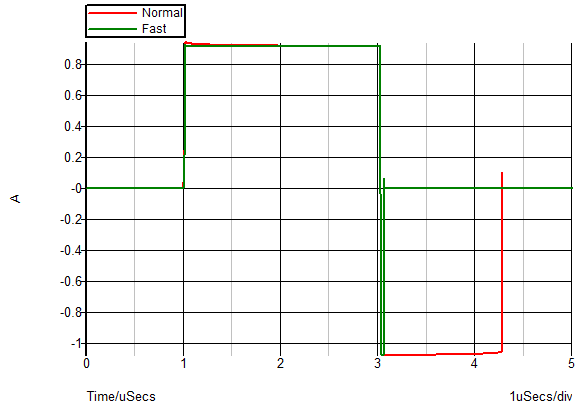
The normal diode is a 1N4001 and the fast diode is the MUR120. The plot is current against time. There is a slight difference in the forward current initially when forward biased, but the big difference is when the input voltage is switched negative and the diode should stop conducting. The fast diode stays conducting for a short time – around 40ns – whereas the conventional diode continues to conduct for more than 1.2us. This is not due to the capacitance of the diodes – the capacitance is actually higher in the fast diode. It is simply that the normal diode is not very quick at turning off.
Used in a conventional mains voltage rectifier at 50/60Hz the 1us turn-off time doesn’t really matter. However, with most power supplies being switching types now, with switching speed over 1MHz possible, you can see how a fast recovery diode will be important. The slow turn-off will affect efficiency and spurious emissions. Switching regulators and switched mode power supplies bring us to the next important diode type – Schottky diodes.
Schottky diodes use semiconductor-metal junctions rather than two different types of semiconductor. They are fast with low forward voltage drop and also have a fast recovery. A typical forward voltage drop would be 0.3V to 0.4V compared to 0.7V or more for a conventional diode but always check because it can be considerably higher. While the difference doesn’t sound a lot, it is very significant in low voltage switching regulators where you might only be generating 1.2V to 3.3V.
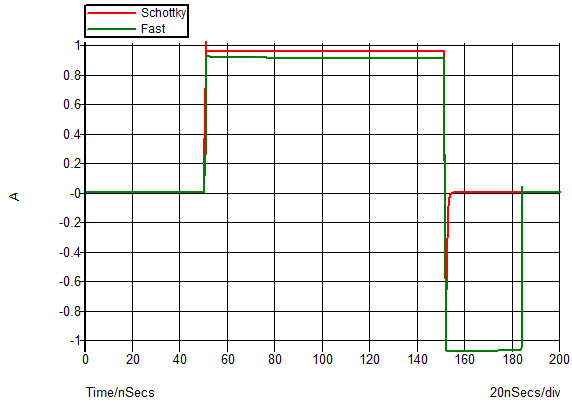
Here is a comparison, on a faster scale, between a Schottky diode (MBRS130) and the MUR120 fast recovery diode shown earlier. You can see the Schottky diode is even faster with a reverse recovery time of around 1ns. While that might suggest that there is no need for fast recovery diodes and that Schottky diodes could be used instead, you will find the reverse voltages for Schottky diodes are a lot lower than for fast recovery diodes. Also, for snubbing applications, fast recovery diodes are better at withstanding high dv/dt and rapid changes from conducting to non-conducting, so there are still applications where fast recovery diodes are useful, as well as high voltage applications. There are now Silicon Carbide Schottky diodes which can withstand very reverse high voltages but they don’t have the low forward volts drop of low voltage Schottky diodes.
Small signal Schottky diodes have uses in other applications such as protection circuitry (due to their low voltage drop) and RF mixers and switches.
Zener diodes have been around for a long time and are designed to deliberately reduce the reverse breakdown voltage of the diode so it can be as low as a few volts rather than 100s of volts. This allows them to be used as a simple voltage reference or voltage clamp. They are not as accurate as a bandgap reference and the differential resistance when operating in the Zener region is not very low. Below is a plot of the voltage across a BZX79-4V7 for positive and negative bias current.

When forward biased it behaves like a normal diode with around 0.6V forward voltage at 5mA. When reverse biased it has around 4.7V across it at 5mA, as would be expected. However, the voltage across the diode increases with current in the reverse direction, as it does in the forward direction. This differential resistance is quoted in datasheets and depends on the nominal current and rated diode voltage. It can be several hundred ohms or just a few ohms depending on the Zener diode and current. If you maintain a constant Zener current then you still have the absolute tolerance as well as temperature coefficient to affect accuracy so they are not normally considered as a high accuracy device.
Varactor diodes are a specialized device that changes capacitance with reverse bias. You are not likely to be interested in that unless you do RF (radio frequency) design. Similarly, Gunn diodes and tunnel diodes are only used in RF and microwave circuit design.
A silicon controlled rectifier (SCR) sounds like it is a diode and the symbol makes you think it is a diode but it is a PNPN junction device and has more in common with a transistor. It behaves like a diode that can be switched on but the current must reduce to zero to turn it off. The control gate cannot be used to turn it off. It is also called a thyristor.

Small signal diodes are normally simply junction diodes for small currents. Examples would be the 1N4148 or 1N914. They are physically smaller with lower capacitance and usually faster than a high current rectifier diode.
LEDs and photodiodes are actually diodes but their attributes are not to do with the current/voltage relationship but their light giving/detecting properties.



Leave a Reply